


At the 41st Warsaw International Film Festival in October 2025, The School Uniform, directed by Martin Z, received the Best Live-Action Short Film award in the Short Film Competition. Accredited by FIAPF, the festival is known for championing formally rigorous and socially observant cinema. The jury praised the film for “telling a multi-layered coming-of-age story with subtlety, through a strong and mature cinematic language.”
Central to that cinematic language is the film’s visual and spatial design, shaped by production designer Lingwei Xiong. With minimal dialogue and a restrained pacing, the film relies on spatial rhythm and visual composition to communicate what remains unspoken.
Set in southern China in the 1990s, the film follows a young boy who is mistakenly identified as a girl and forced to wear a red girls’ uniform in the lead-up to a school arts performance. Moving between a crowded family restaurant that doubles as home and a school governed by discipline and display, he learns to remain silent under pressure, misrecognition, and quiet humiliation—until that silence is finally interrupted.
Space as Narrative Structure
Without relying on overt conflict, the film conveys oppression, shame, and identity anxiety through visual tension embedded in the spatial logic. Xiong explains, “Rather than treating the sets as neutral backdrops, I wanted each environment to function as an active narrative force—one that regulates movement, holds emotion, and applies pressure—allowing meaning to emerge where words remain absent.”
The School Uniform unfolds across two primary environments: a small family restaurant that also serves as home, and a public school defined by order and routine.
At home, space is dense and constantly interrupted. Furniture crowds the frame, business spills into private life, the boy completes his homework wherever a surface happens to be available, such as a shared table in the restaurant. The environment bears traces of everyday labor—grease-stained surfaces, aging posters, and layers of use accumulated over time. Warm colors appear throughout, yet comfort never settles. The atmosphere feels worn and quietly suffocating.
Xiong worked almost entirely with real locations. She reorganized the existing layout, adjusted actor movement, and curated secondhand furniture and everyday objects from local markets. Each item was chosen and aged to feel lived-in rather than staged, reinforcing a sense of familiarity that offers no refuge.
The school presents a different restraint. Classrooms and corridors are pale, symmetrical, and visibly orderly, lined with slogans and institutional graphics that prioritize discipline over care. Movement is regulated, individuality minimized, and silence quietly enforced. Misidentified and isolated, the boy moves through school under constant anxiety—often late to class, fearful of using the boys’ restroom, and burdened by small humiliations he has no language to name.
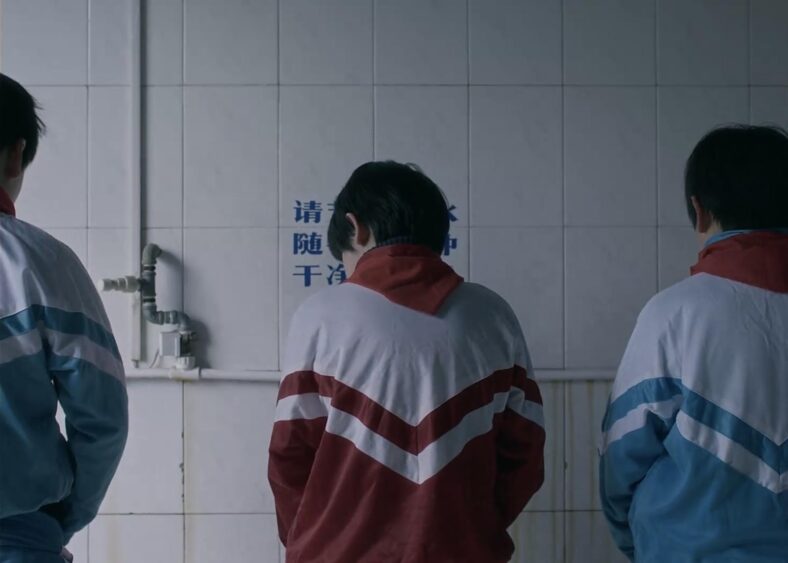
As director Martin Z observes, “Through textured set design and the use of warm and cool tones, the production design precisely recreates the atmosphere of southern Chinese cities in the 1990s, giving the film a distinctive sense of nostalgia.” Despite their visual contrast, both environments exert a similar pressure, leaving little room for privacy, expression, or emotional release.
Color, Control, and the Stage
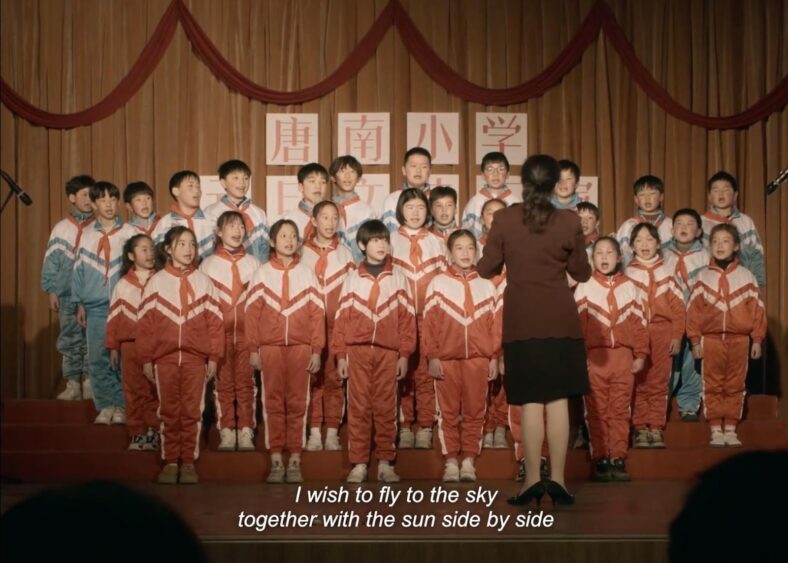
The film’s most striking visual symbol is the red and blue school uniforms—assigned markers of identity rather than chosen ones. Xiong deliberately suppresses the surrounding palette, allowing these two colors to stand out with unsettling clarity.
This visual system culminates in the school’s arts performance. The stage abandons restraint entirely: gold curtains, red banners, ribbons, and harsh lighting saturate the space. What should feel celebratory becomes excessive. Choreography is orderly, smiles rehearsed, and under the glare of the lights, individuality dissolves into uniformity. Here, color no longer signifies vitality or joy—it heightens visibility while denying agency. The stage marks the film’s most rigid visual moment, setting the conditions for what follows.
Fire as Interruption
The final scene ruptures quietly. At the emotional peak of the film after the stage scene, the boy removes his red school uniform and throws it into the arts-performance poster he has just set on fire. The fire is contained, yet enough to light both the schoolyard and what had remain unspoken.
Xiong does not frame this moment as an act of rage or destruction. “I don’t see the fire as an explosion,” she says. “The film’s narrative is delicate and empathetic, not about intense resistance or anger. It invites reflection on growth, identity, order, and self-expression. The fire replaces language—it briefly disrupts an assumed order and opens an outlet for a silent character.”
To achieve this moment, Xiong and her team tested materials and ignition methods in advance, carefully controlling how the fire appeared on camera so it felt deliberate rather than chaotic. In a film where constraint governs both space and behavior, fire briefly punctures the system—allowing meaning to surface without explanation. The gesture is small, almost fragile, yet it marks the boy’s first unmistakable act of self-definition.
From Architecture to Film
Lingwei Xiong did not enter cinema through a conventional route—her creative practice is rooted in architecture. After earning a Master of Architecture from Cornell University, she worked in New York as an architectural designer at internationally recognized studios including SO-IL and Groves & Co., contributing to high-end residential and interior projects such as One Seaport and Waterline Square. At SO-IL, she also contributed to international design competitions, including the New Museum expansion proposal in New York. These architectural contexts shaped her understanding of space, scale, and human experience—foundations that later informed her approach to cinematic design.
“Architecture is a form of spatial storytelling,” she says. “Film operates in much the same way—I’m simply shifting space from the physical world into a cinematic one. It’s all about how environments shape perception, behavior, and emotion.” She has also taken acting and filmmaking courses at the Central Academy of Drama in Beijing and NYU’s Tisch School of the Arts, further informing how she approaches performance and emotion through space.
Across disciplines, Xiong’s work has received international recognition, including a Gold Award from the Muse Creative Awards for brand identity design and a Gold Award from the American Good Design Awards for an architectural project. Her previous film-related work has also been recognized at major international platforms: Xiaohui and His Cows received a Special Mention of the Generation Kplus International Jury at the Berlin International Film Festival; Return to Youth earned an Honorable Mention for Best International Short at the Norwegian Short Film Festival; and Dinosaur Boy was selected for the Pingyao Corner section of the Pingyao International Film Festival.
Holding Space
For Xiong, the recognition of The School Uniform marks a moment of confirmation rather than conclusion. She continues to explore how space can participate more directly in performance—how environments can become a shared language between directors and actors, allowing emotion to emerge through physical presence rather than dialogue.
In her work, space is not asked to explain itself. It is asked to hold.


