


Editor Evan Schiff got hired on Frankenstein by putting himself out there: Though he hoped his representatives and his resume would be enough to capture the attention of writer-director Guillermo del Toro, Schiff also DM’d the director directly to tell him how much it would mean to him to edit his monster epic.
Del Toro remembered Schiff from his work as an assistant editor on the director’s 2006 film Pan’s Labyrinth and his 2008 Hellboy 2: The Golden Army. Since working on those hits, Schiff had also become a high-profile editor of films including Nobody, Birds of Prey, The Marvels, John Wick: Chapter 2, and John Wick: Chapter 3 — Parabellum.
“I think everybody is looking to help everybody else rise up the ladder, but if they don’t know what you want, they can’t help you do that,” he says in our interview about hand-crafting the Oscar contender, which you can watch here or above.
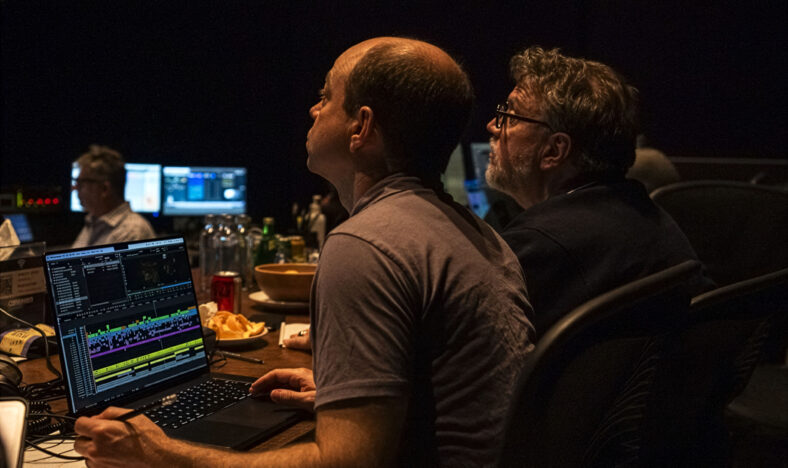
After his extensive experience with action movies, Schiff was eager to work on an “epic drama — and a Guillermo del Toro movie on top of it.”
While many editors shape a film after shooting, Schiff had a significant hand in Frankenstein even on the set. Del Toro likes to show his cast and crew scenes from the film very soon after he shoots them, which meant Schiff would routinely start editing the past days’ footage four hours before the crew call, and del Toro would arrive after two hours to look over his edits.
“And we would spend those two hours, usually from like six to 8 a.m., refining the cut and getting into the state where it’s actually pretty solid,” Schiff recalls.
About three months into shooting, del Toro invited the entire cast and crew to start looking at edited footage each morning.
“The next day, there were like six people outside my office door at 6 a.m., and it was great,” Schiff recalls. “And that lasted for like the whole next month.”
Because Schiff edited so much on the Toronto and Scotland sets of the film, the film was fairly far along in the editing by the time it finished shooting. He edited on Avid Media Composer software, and praised his first assistant editor, Brit DeLillo, as “a genius.”

Evan Schiff on Understanding Every Department on a Film
As the Syracuse native recounts on his website, EvanSchiff.com, he started interning at Stan Winston Studio (now Legacy EFX) at the age of 16. He later attended USC’s film production program, where he developed his love for editing. Then he worked in VFX and became an assistant editor, which led to his work as an editor.
Understanding other departments helps him be a better team player.
“Working with sound crews and script supervisors and talking with DPs and things like that is all very informative to me as I start editing, because it allows me to not only have knowledgeable conversations with those department heads when I need something from them, but also to keep an eye out for things that they’re sending my way that may need a little bit of love from me, in order to make them the best that they can possibly be,” he says.
Early in his career, he learned a lesson from reading interviews with another of Syracuse’s favorite sons, Tom Cruise. The actor talked about how when he first started working on film sets, he would talk to everyone about what they did, in order to better understand the entirety of filmmaking.
In 2011, Schiff worked on Cruise’s film Mission: Impossible — Ghost Protocol, and was dispatched on a secret late-night mission to Pittsburgh, as part of a team showing Cruise edits from the film.
“So that was pretty fun,” Schiff laughs.
Frankenstein Editor Evan Schiff on the Limits of AI
Last year, as del Toro accepted the Vanguard Tribute for Frankenstein at the Gotham Awards, the director famously quipped, “F— AI.” He noted: “I’d like to tell the rest of our extraordinary cast and our crew that the artistry of all of them shines on every single frame of this film that was willfully made by humans, for humans.”
That’s certainly true of Schiff’s work. While he says AI might be capable to some elements of editing, it isn’t capable of heart or the complexities of understanding what a filmmaker — or an audience — wants and needs.
“So much of my job is managing the politics of what goes on in my room, managing multiple interested parties, people who have conflicting notes,” he says. “This is not Guillermo, but sometimes you get a director that doesn’t know what they want, and you’ve got to kind of interpret the note behind the note. Or they just come in like, ‘Something feels wrong here, but I don’t know what it is.’ And I don’t think that artificial intelligence is that intuitive. It’s also trained on past problems and past scenarios, and that, by definition, prevents it from coming up with something new.”
Frankenstein is now streaming on Netflix.
Main image: Evan Schiff while editing Frankenstein. Courtesy of Evan Schiff and Netflix.


