


Greenland 2: Migration director Ric Roman Waugh comes from the world of stunts, and knows what you can accomplish through movie magic, and what you can’t.
“I understand what inertia means, and you can’t fake inertia. A lot of the time, you have to do it for real,” he says. “It’s why we still crash cars for real.”
That commitment to realism is why he dropped a ceiling on Gerard Butler and the other stars of his new post-apocalyptic picture, which follows the Garrity family through a world besieged by comets. It opens Friday.
“There’s a real art to it,” says Waugh, who did stunts on films including Days of Thunder and The Last of the Mohicans before moving into writing and directing. “I was lucky to have the team that I have around me to do all that stuff properly.”
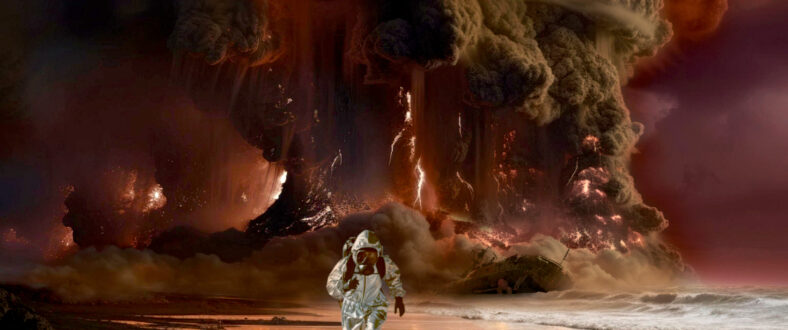
That team included visual effects supervisor Marc Massicotte, who researched natural disasters around the world to figure out how they should look on the screen, and how he could exaggerate their scale for an extinction-level global catastrophe. He even shot a real volcano erupting for the film’s opening sequence, and studied footage of underground bomb tests as references for a bunker implosion.
“I always start digging into reality,” he says. “Like, how would this world really be if it did happen?”
He has been working with Waugh since they first collaborated on 2019’s Angel Has Fallen, the third film in another Butler franchise. Waugh and Massicotte’s world-building begins in camera, and they only rely on CGI to enhance what’s captured organically.
Their approach to the art of destruction is best exemplified in the first act’s cataclysmic collapse of the Greenland bunker.
It’s a pivotal moment in the protagonists’ continued quest for survival in a world wrecked by comet collisions both big and small. Audiences saw the largest impact at the end of the first film, when the Garrity family made it inside the military-grade bunker just in time to avoid the global blast of a massive fragment striking the south of France.
The new film is set five years later, amid rumors that the crater may actually be a cradle of life in a dying world plagued by radioactive lightning storms, tidal waves, comet showers and civil unrest — to name just a few of the obstacles Butler’s character, John Garrity, has to fight through this go-around.
He’s joined again by Morena Baccarin as his wife, Allison, as the couple try to protect their son, played this time around by Roman Griffin Davis.

The title and trailer of the film make it clear the family go beyond Greenland in this one, and the inciting incident is a bunker-busting earthquake that forces them to make a move across land and sea. Though the sequence only takes up a few minutes of screen time, Waugh says it took about four months to plan and two weeks to shoot, blending the careful craftsmanship of set design, stunts, cinematography, CGI and mechanical engineering to pull it all off.
“We did everything in camera, practically. It wasn’t the camera shaking. When you see lights swaying and people getting thrown, that’s from our shaker floor system,” he explains.
Massicotte adds: “A lot of us buckled at the knees and fell down. As safe as it was, it still always catches you by surprise when it starts moving, which adds to the intense realism.”
While Massicotte and his team of compositors used digital effects to “accentuate” and “add to the impact,” the bulk of the action was captured in real time.
Greenland 2: Migration and the Art of Disaster

Which brings us back to the ceiling drop. Production designer Vincent Reynaud and the rest of the team searched carefully for materials that could be dumped on humans without hurting them — or looking cheap and cheesy on camera.
“Everything from balsa wood to big pieces of foam,” Waugh says of the materials they chose.
Months of discussion and tests went into answering some crucial questions: “How do you build something in foam to look like a steel girder, or a big piece of concrete that doesn’t bounce off the floor, or doesn’t squish or move?” he asks.
Part of the reason Waugh didn’t want to rely on CGI was because he wanted better reactions from his actors.
“You don’t want a bunch of fake CG stuff, telling people, ‘Hey, imagine you’re collapsing on the floor and stuff is falling on you.’ It doesn’t really work that way. It looks fake,” he explains. “So we drop stuff on people; we do it where it’s heavy enough that they can feel it and react to it properly, but you’re not going to concuss somebody or hurt them.”

The carefully crafted chaos is a reminder that filmmakers shouldn’t blow off math and science classes.
“I tell my sons to pay attention in math and school, because we’re constantly dealing with physics,” says Waugh. “We’re constantly dealing with calculations to keep people safe, but also to bring as much live-action stuff to the screen as possible.”
The crew recreated the bunker set that audiences will remember from the original Greenland. But this time, it’s got post-apocalyptic wear and tear, and was built on a huge hydraulic device capable of rocking and rolling it all down to the ground.
Special effects supervisor Terry Glass (Gladiator II) spearheaded the in-camera effect at a rare, massive scale, using a 100 x 100-foot platform that could support 60 or 70 performers while also tossing them around.
Meanwhile, cinematographer Martin Ahlgren set up and locked in enough cameras to capture the ceiling collapse from as many angles as possible, because the complexity of the sequence only allowed Waugh and his team to do it once per day.
“I like my action to almost be like it could be done as a documentary, like it can continue as long as I can possibly sustain it. So you’re, one, giving people the illusion it’s for real, because you’re doing it for real, and then, two, it also gives you the ability to cut at the critical moments for emotion or for the best part of the story, versus cutting because the shot fell apart too early,” Waugh says.
“The set decorator’s nightmare was we would have everything be in the drama scenes with nothing destroyed, and then the very next morning we would come in and we’re just completely wrecking the place. And then sometimes you have to put that stuff back to the way it was, because of scheduling and everything else.”
The realism came at a cost, but Waugh believes it was worth the investment.
“The first movie was half the budget,” he says. “But that’s what you do when you start an original IP where you’re not working from a comic book or some book or so forth.”
He adds: “We were lucky to get more money to make the second one, but that money got soaked up pretty quickly with the visual effects, the textures and production design. … Now you actually have to do an entire set design of how the Earth was destroyed, what buildings are gone, what the roads look like, and how they were melted. So, you’re glad to get more money, and then you realize it just got spent really quickly.”
The ultimate goal was to get every shot right, safely.
“It’s never changed since I started out in this business as a young kid in stunts. We’re always trying to make sure everybody goes home at the end of the day, and that includes the crew as well,” Waugh says. “So, you could rush all this stuff and you can shoot it a lot faster, but then you just put far more people at risk and also you don’t get the quality.”
Greenland 2: Migration arrives in theaters Friday from Lionsgate.
Main image: Gerard Butler in Greenland 2: Migration. Lionsgate.


