


Stephen Mirrione didn’t cut the racing sequences in F1: The Movie the way he’d cut a dialogue scene. He couldn’t: The actors weren’t in the footage yet.
Directed by Joseph Kosinski, F1 stars Brad Pitt as Sonny Hayes, a former Formula One driver who is recruited back into the sport to help revive a struggling team owned by Ruben (Javier Bardem). Hayes is paired with a younger driver portrayed by Damson Idris. Much of the film was shot at real tracks during actual race weekends, with production working within tightly controlled time windows alongside the live sport.
By the time Brad Pitt and Damson Idris shot their in-car material, Mirrione had already been building the races from stunt work and broadcast cameras.
“We had a lot of that material and a lot of the stunt material and the broadcast cameras,” says Mirrione, who is Oscar nominated for his editing on the Apple hit. “Before we had the actual performances of the drive, Brad and Damson driving the track, I was able to build that framework first.”
He worked from the script and storyboards, pulling the strongest angles and mapping out position changes and story beats. To make it legible, he used temporary graphics and subtitles to track who was where and why it mattered.
“I layed that out as a sketch, as a blueprint for what the scene would be, using subtitles and temporary graphics and things, so that we could start to understand what the scene was.”
The tracks dictated the structure, and certain moments had to happen at specific turns as the lap itself imposed limits.
“I would almost compare it to a musical where you’ve got this choreography that, in terms of the race itself, you have to work within that framework,” he explains.
Mirrione sent them early cuts to director Joseph Kosinski and the stunt team, who adjusted their approach based on how the sequence was playing.
“They could analyze them and adjust events to the turns,” he says, adding that overall flexibility was essential.
“When I was putting that together, I was being pretty loose about it, because I knew the performances were ultimately going to be the thing that dictated what I really cared about when watching the scene.”
Stephen Mirrione on Editing Together Racing, VFX and Dialogue for F1: The Movie
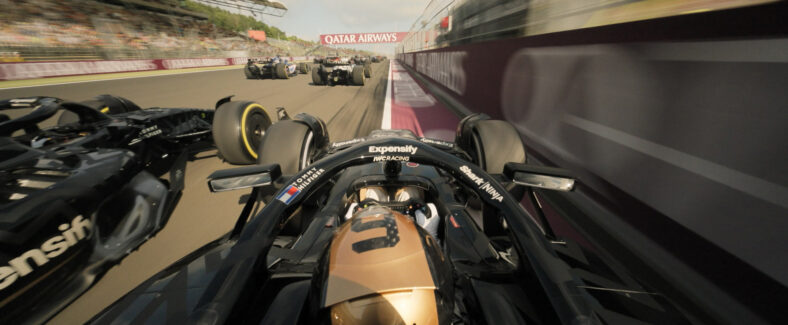
Visual effects were also already in progress by the time Pitt and Idris’ material came in. As a result, Mirrione could see what the reskinned cars or crowds would look like, and only needed to add the performances into the existing build.
“Then it was a matter of going through and ensuring the plan we had set up was working, starting to find the best performances and sliding those in,” Mirrione explains.
The editor, who won an Oscar for best editing on Traffic in 2001 and has been nominated three times since, including for his work on F1, says this film was an incremental process that involved paying attention to all of the tiny details.
“In this movie, stepping out and getting the macro view came much later,” he says.
Because of those myriad components, Mirrione had about 10 times more footage to work with than he usually has. He and his 12-person team had to catalogue and track materials as they came in so that they could easily access what they needed when the right moment arose.
“It’s about planning ahead,” he says. “Making sure there are contingencies, making sure you know exactly what you’re doing, so that when things start to go wrong, which they always do, and things need to change, you’re totally prepared to shift and pivot with that.”
Mirrione says it’s easy to name the most challenging sequence to stitch together.
“The race of Abu Dhabi was almost like a movie unto itself,” he says. “Everything about that race was just a gigantic task — the organization of it, the storytelling, blending the visual effects with the production footage.”
The Abu Dhabi race was captured in two shoots, six months apart. At first, when there wasn’t an active race, the filmmakers gathered controlled material. Then, during the actual event, they had three or four units stationed at different points along the track, capturing moments that had to unfold in real time alongside the race.
“There was a lot of pressure,” Mirrione says. “Everything had to go perfect because the window was closing for being able to pick anything up or fix anything.”
That pressure landed squarely in the edit bay. Footage had to be delivered to him quickly at the end of each day, assembled fast, and evaluated even faster. Everyone knew that once the race ended, there was no going back.
On that final day in Abu Dhabi, Mirrione screened the assembled sequence and flagged something that wasn’t landing.
“I told Joe that when we’re wrapping everybody’s story up, I felt like Kate (Kerry Condon) was being shortchanged,” he recalls. “It was her car, it was her invention for the car that caused this win. And everybody else was getting a little bit of a dialogue of congratulations.”
The film added a moment between her and Ruben, and that scene ended up being one of several refinements that came after watching the full sequence.
“It’s just a constant, layered process of all these little micro decisions,” Mirrione says.
F1: The Movie is now streaming on Apple TV.
Main image: Damson Idris and Brad Pitt in F1: The Movie


