


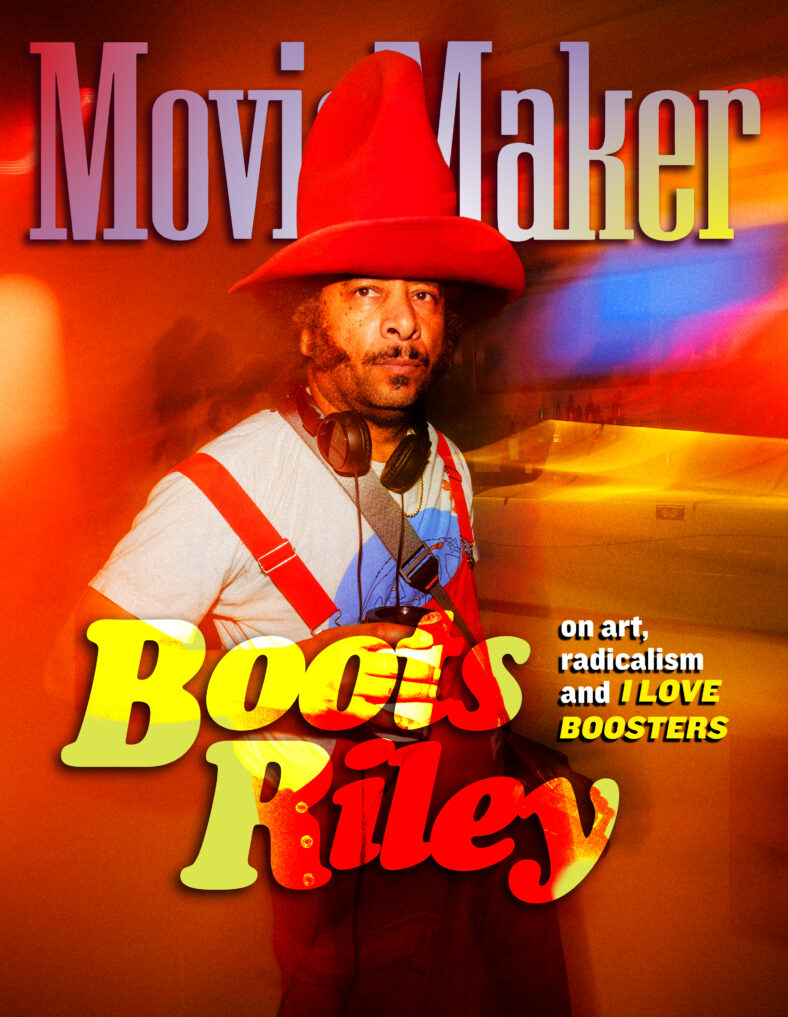
“I’ll look for any excuse to do something else,” says I Love Boosters writer-director Boots Riley of his creative process.
His passion has never been in doubt — Riley’s been a labor activist since he was a teenager, and a working musician since he was in college — but he still loves a convenient distraction.
“Every time I fell in love,” he says, “I was supposed to be writing an album.”
I Love Boosters is no easy escape. A maximalist carnival ride about women up and down the clothing supply chain,the film is an engaging look at fashion and exploitation through the lens of three boosters, or shoplifters, nicknamed “the Velvet Gang.”
Deeply unpredictable and riotously fun from start to finish, I Love Boosters is also a surprisingly heartfelt project about friendship and female allyship. Like all of Riley’s projects, it’s firmly grounded in his labor activism and political beliefs. But unlike other projects in the recent wave of the “eat the rich” films, I Love Boosters is devoted to ideas of collective power and labor rights.
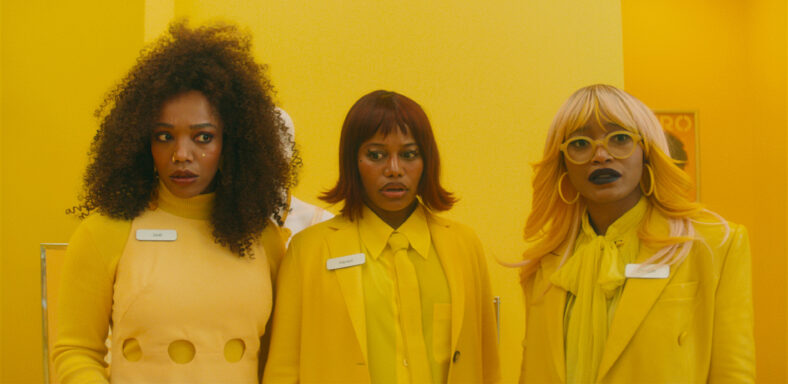
The Velvet Gang is comprised of Corvette (Keke Palmer), Sade (Naomi Ackie), and Mariah (Taylour Paige), three young women who have been just barely scraping by in Oakland through boosting from their favorite store, Metro Designer.
Corvette, an amateur fashion designer, idolizes the visions of Metro Designer’s CEO, Christie Smith (Demi Moore at her absolute girlbossiest) despite the company’s sketchy labor practices. When the women learn more about how Metro Designer exploits not just their underpaid retail employees but also the Chinese factory workers creating the garments, they decide Smith has to be taken down.
With the help of garment worker Jianhu (Poppy Liu) and retail-drone-cum-labor-organizer Violeta (Eiza González), the women scheme to crash Metro Designer’s upcoming fashion show and destroy the company for good.
The origins of I Love Boosters are in the song of the same name Riley performed with his hip-hop funk group, The Coup, for their 2006 album, Pick a Bigger Weapon. The song is an upbeat celebration of the women who, as Riley explains in the song, “jacks from the retail/And sells it in the hood for dirt-cheap resale.”
He worked on the script for Boosters after his first feature, Sorry to Bother You,premiered in 2018, though the project took a pause while he focused on his 2023 television series I’m a Virgo.
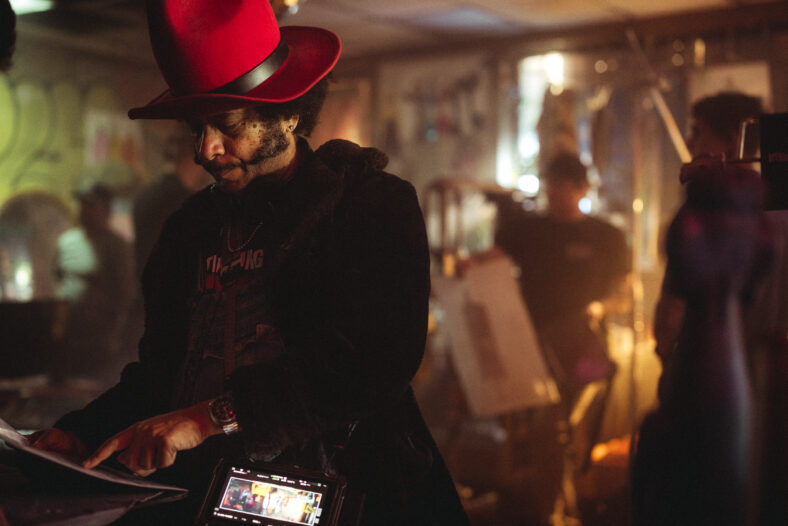
Boots Riley, Under the Hood
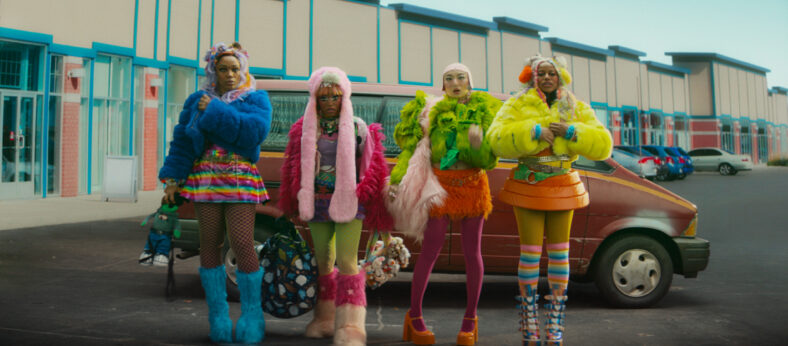
Both the musical and cinematic iterations of I Love Boosters honor the young women working in a precarious underground economy, while examining the chain of exploitation that allows clothes to be produced cheaply to profit the ruling capitalist class. While Riley is critical of consumerism, he’s not anti-material. The film’s bold costumes, wigs, and makeup pay tribute to fashion as art and expression.
Riley’s aesthetic vision is characterized by vibrant colors, surreal imagery, and intricate practical effects. A strong visual presentation was always a part of his musicmaking process.
“When I came up doing music, aesthetics were always a huge part of it. It might have been different considerations from now,” he explains. “People were aiming to look like they just got up like this and didn’t care. But there’s a lot that goes into looking like you don’t care.”
One joy of Boosters is how Riley pulls off a series of magic tricks that make the impossible look easy. Amidst wild, inventive production design are extensive stop-motion sequences, inspired by Riley’s love for miniatures.
“Between my second and third album, I quit making music.” Riley says. “I started labor organizing, and I decided to take apart and rebuild a Volvo engine. I thought it would be a good learning experience. It took six months, and it still didn’t start. The other thing was that I got into miniatures. I had this fine art plan to build all these miniature rooms. This was before eBay — I was going to garage sales and dollhouse stores and swap meets. Then I realized I could maybe get a gallery show and 12 people would see it. I thought, What the f— am I doing? and sold all of it. And then I went back to music.”
By then, the organization Riley had been working with had fallen apart, though he would remain active in various labor movements. As for the Volvo? “I did learn a lot. I learned I was partial to impulse, and that I could figure things out under the hood.”
A solid sense of inner workings makes I Love Boosters feel grounded despite its cartoonish elements. The relationship between the members of the Velvet Gang are warm and loving, but also complicated and sometimes uneasy. That dynamic starts with Riley’s characterization.
“I go a little bit at a time,” he says. “I’m checking, mainly, to see whether folks are real. Looking at little things that represent aspects of their character. It might just be a line. It might be a prop they’re holding.”
Sometimes, the voice comes first. He wanted Corvette to sound like Oakland-based rapper Ally Cocaine, whose song with 10 Piece Tone, “Boss Type,” was featured in I’m a Virgo.
“When Keke was on board, I said, ‘Oh, listen to this.’ And she said, ‘Well, doesn’t that already sound like me?’” Palmer also makes another major sonic contribution to the film — her voice is on the soundtrack.
“My daughter wrote the song, ‘Cassandra.’ I originally thought the song might be too slow for the end, but one day on set I played it for Keke. She started crying, asked to hear it again, and then was like, ‘We got to put this in the movie.’ So she ends up singing in the final version that appears in the film.”
The Pop and Magic of I Love Boosters
The band Tune-Yards, which scored Sorry to Bother You and I’m A Virgo, also provide a bouncing, high-energy score for Boosters.
“I’m influenced by other music that’s collage-like,” Riley explains. “From Parliament-Funkadelic to the Bomb Squad. People taking different textures, colors, genres and slapping them on top of each other.”
Riley’s childhood was informed by mainstream pop culture. “I didn’t grow up listening to underground music,” he says. “I grew up listening to the radio; I knew Stevie Wonder and the Ohio Players, not obscure soul. Same for movies and television. I had a heavy bed of E.T., Fat Albert, The Land of the Lost, The Goonies. But my older brother used to take me to a 24-hour kung fu theater.”
Those influences are clear in Riley’s work: the 1985 cult classic The Last Dragon gets a shout-out in Sorry to Bother You and there’s a distinct Looney Tunes sensibility to I Love Boosters’s action sequences.
But Riley is also inspired by the great magical realist novelists of the ’80s: Gabriel Garcia Marquez, Toni Morrison, Salman Rushdie. Riley has mentioned Rushdie in previous interviews, and Midnight’s Children makes a brief appearance in Boosters.
Rushdie’s Booker Prize-winning novel imagined a world where all children born in India at the date of the country’s independence from the British have magical powers. It’s an idea that pops up in I’m a Virgo, which follows the adolescence of a 13-foot-tall young man who encounters other young Black people with similarly strange abilities.
“They’re dense, and syrupy,” Riley says, to explain his attraction to surrealist novels. “There are absurd situations, but there is also beauty. And they’re doing stuff with words, and descriptions, and names.”
Speaking of names: If you were wondering about the etymology of the Velvet Gang, Corvette’s name is indeed inspired by the 1983 hit single, “Little Red Corvette,” by Riley’s childhood hero, Prince. The other girls in the gang are named for legendary vocalists Sade and Mariah Carey, while Jianhu is named for a revolutionary Chinese warrior.
I Love Boosters’ clear adoration for fashion and style might at first seem in contradiction with Riley’s communist politics. But Boosters argues that it’s not wrong to desire a world filled with beauty and art; it’s wrong to forcibly take that beauty through exploitation and stolen labor.
“When I’m designing, I feel like I’m touching the world,” Corvette says early in the film. Her artistic ethos stands in stark contrast to Smith’s, even though the two share some aesthetic overlap. Smith explicitly refers to people as a canvas she manipulates. Both the workers she exploits and the people she sells to are tools. She balks at the idea that someone like Corvette — who Smith at one point calls a “low-class urban bitch, with all due respect to urban bitches” — could have her own individual artistic taste.
But Riley is clear that it’s not individuals like Smith who are the problem; it’s the system that Smith upholds that allows people like her to thrive.
How to Rebuild the World
Though I Love Boosters predates the moral panic around an alleged spike of “organized retail crime” that was later proven to be false, Riley was thinking a lot about how law enforcement has attempted to reframe crime in the public’s mind.
“Police unions, in the wake of George Floyd’s murder, all hired publicists. Their goal was to make the public think they need the police,” he says.
Riley noticed the rise of Instagram pages claiming to be accounts about events and culture in the Bay Area that quickly turned into pro-police propaganda. When he looked deeper, he says, the images turned out to be stolen, and the names attached to them were fake.
Riley has been focused from the start on the manipulation of media to skew opinion: In The Coup’s 1994 song “Fat Cats, Bigga Fish,” his character poses as a waiter to infiltrate a group of corporate elites and eavesdrop on their scheme “to make some condos out of low-income housing.” One rich man says to another: “Immediately, we need some media heat/To say that gangs run the street and then we bring in the police fleet/Harass and beat everybody ‘til they look inebriated/When we buy the land, motherf—as will appreciate it.”
Local news fills the world of I Love Boosters, as seen through a funhouse mirror: There’s an army of talking heads with titles like “Crying Black Mother” and “Upstanding Community Member.” Absurdist characters appear across televisions to argue that low wages are actually liberatory, and that rent stabilization limits people’s freedom to pay more rent.
If the entire system is rigged toward exploiting workers, what is the solution?
“A mass, militant radical labor movement,” Riley says, without hesitation. “The withholding of labor as a tactic and strategy to demand the policy changes we need, by attacking the ruling class at their base of power. That’s the beginning of a movement that can reshape society and reshape the world.”
Riley was an active participant in the 2023 WGA strike, and at the time, he spoke about the unexpected joy many writers experienced on strike. Instead of being cooped up to work alone on writing projects, writers got to be in community with each other.
Shared struggle is a recurring theme in Riley’s work, and he is mindful of the influence his art can have on audiences. At the same time, he’s careful to avoid over-intellectualizing scenes. “It takes some of the poetry out of it,” he says.
Boots Riley on Those Wobbly Feelings
Riley sets the Metro Designer headquarters in a slanted building that resembles San Francisco’s Millennium Tower, the infamous skyrise that has sunk nearly 30 inches since construction. The floor of Smith’s office is at a nearly 45 degree slant, which only she seems able to comfortably navigate.
Like the equisapiens of Sorry to Bother You that are a literal and metaphorical representation of how capitalism dehumanizes workers, the crooked floor is both a symbol of the impossibility of navigating capitalism and a physical source of cartoonish comedy.
“I have a gauge,” Riley says, on balancing the movie’s wackiness. “But I couldn’t tell you what the rules are around it. It’s like asking what your rule is for whether a song should be in B or C Major. I don’t use the Do we need it? rule in filmmaking. We don’t need any of it. We do it because it’s fun. If we were trying to make the most efficient story, it’d be two sentences.”
The shagginess of I Love Boosters is one of the best parts of the ride. And Corvette isn’t the sole heroine: Each member of the Velvet Gang has a fully realized story arc, no small feat in a movie that comes in at under two hours.
Though the film is a clear-eyed call for collection action and revolution, it still grounds the story in characters who feel like real, if exaggerated, young women.
“I’m writing these things from a very personal place,” Riley says. “The characters represent the realities of those day-to-day experiences. There are so many emotional struggles that aren’t discussed in art. I think a lot of hip-hop didn’t talk about the things in between, things like joy or uncertainty, because it requires the art to open up. In film, when you’re dealing with bigger plot points and bigger ideas, those wobbly things aren’t worth the real estate on the page. But that’s what makes the characters interesting. I want to reflect those wobbly feelings in my films.”
Self-growth is a major theme in Riley’s work: the notion that you can, and should, always be coming of age.
“You’re making yourself,” Riley says, “into the person that you need to be.”
I Love Boosters arrives in theaters Friday from NEON.


