


Frankenstein composer Alexandre Desplat knows one of his scores is working when it makes Guillermo del Toro cry.
“He’s very sensitive to music. Guillermo loves music,” says Desplat, who won his second Oscar for his first collaboration with del Toro, the 2018 Best Picture winner The Shape of Water.
“He reacts to it very well. He reacts to it in his films. And when I find the sensitive spot of emotion, he just responds with tears. It’s the most beautiful thing for me to watch and share.”
Frankenstein marks the third collaboration between del Toro and Desplat, who won his first Oscar for 2014’s The Grand Budapest Hotel. The prolific French composer sees Frankensten, for which he is up for a third Oscar, as the conclusion of a triptych that also includes del Toro’s Pinocchio.
“It’s the grand finale of this trilogy, of this triptych — The Shape of Water, Pinocchio and Frankenstein —about creatures and how about we can, despite our differences, love the other and have empathy for creatures, or for things that are different than who we are,” Desplat explains.
“So the challenge is that because it’s the grand finale… it’s more music, the orchestra is huge, and at the same time, we go through very minimal emotions, which means very minimal orchestration.”
Desplat says a composer has two responsibilities, function and fiction. Function means serving the film — connecting scenes, underlining points of emphasis, providing repeating themes that cue an audience’s emotions.
Fiction is about emotion.
“Fiction to me is the weight of the imagination that you bring to a film, what a composer can bring.,” says Desplat. “It’s the composer’s job to imagine something that is not yet there in the film.”
For example: Using the most delicate of string instruments to represent a monster.
Alexandre Desplat on Using the Violin to Represent the Creature in Frankenstein
Desplat wanted a particular sound to represent The Creature, played by Jacob Elordi, who is brought to life by Oscar Isaac’s obsessive Victor Frankenstein. The composer experimented with big electronic noises, as well as bass and cello, before deciding they were all “too obvious.”
So instead of leaning into The Creature’s power and ferocity, he emphasized his sensitivity.
“The violin is the most sensitive, most beautiful, the purest sound. It’s the smallest, lightest instrument. It’s extremely fragile,” Desplat says.
He noted that del Toro cast Elordi as The Creature in part “for his eyes. There’s something in his eyes that is very beautiful and fragile and delicate.”
The violin also made sense because while some people may see the Creature as a monster, Frankenstein sees him as “a Stradivarius” — one of the finely made, intensely prized stringed instruments made by Italian luthier Antonio Stradivari, centuries ago.
For the Frankenstein soundtrack, appropriately enough, violinist Eldbjørg Hemsing played a Stradivarius.
Desplat has a special relationship with the instrument. He is married to a violinist, Dominique Lemonnier. When he conducts the orchestra, she sometimes helps him “to approach the interpretation in a more elegant way, and help the string section to be even more accurate in every aspect,” he says.
Desplat says that sometimes, if his scores are too restrained, del Toro, who was born in Guadalajara, will ask him to be “more Mexican.” It’s a joking way of asking him to “unleash the orchestra, which means add more instruments to the orchestration and make it sound lusher.”
Does Desplat ever cry at his own music?
He laughs.
“I never cry,” he deadpans. “Frenchmen never cry.”
Frankenstein is now streaming on Netflix.
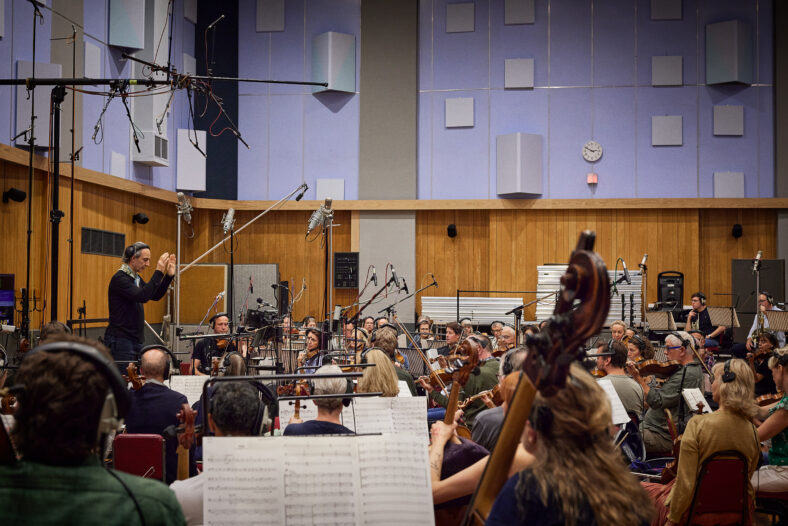
Main image: Alexandre Desplat conducts the orchestra for Frankenstein. Photo by Xavier Forcioli. Netflix.


