


Costume designer Kate Hawley still remembers the first time she read Guillermo del Toro’s script for Frankenstein. It wasn’t the spectacle or the split point of view that stayed with her; it was the feeling she got.
“It was just deeply moving,” she says. “I had tears pouring down my face. Guillermo says I cry at everything, but I cry because it’s moving.”
Hawley immediately knew this version of Frankenstein would be shaped by those emotions rather than traditional Gothic horror. Del Toro is known for sketching images for his films, and Hawley reveals he gravitated toward Caravaggio for visual inspiration and color that imbued ideas of religion and mythology with romance and humanity.
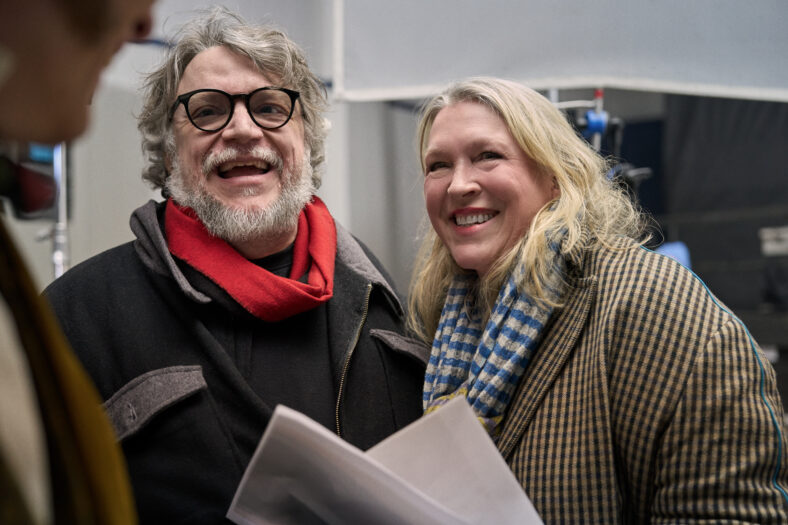
“That gave the weight of a romantic tragedy, as opposed to just merely Gothic,” explains Hawley, who is up for her first Oscar for Frankenstein.
In del Toro’s Frankenstein, creation isn’t just about the physical. Through color, texture and silhouette, Hawley helped construct a world where every character carries their history on their body. It’s emotional architecture, carefully built to support the film’s humanity as much as its horror.
Because of that, costume became less about recreating a historical period and more about defining the characters’ emotional realities. Hawley describes how once those key visual ideas emerged, everything else fell into place.
Kate Hawley on a Key Reference Point for Frankenstein

“The pigeon blood red that he referenced from Caravaggio, that was the glue that held us all together through the whole visual storytelling,” Hawley adds.
The connection became especially important when designing The Creature (Jacob Elordi). Once del Toro firmly rooted the story in the Crimean War, Hawley began to see Victor Frankenstein (Oscar Isaac) and his creation not as opposites, but as reflections of each other.
“Both The Creature and Victor are mirroring each other. They’re different sides of the same coin,” she says.
Where the characters differ is within the actors themselves. Hawley studied Elordi’s physicality and movement during fittings for the role of The Creature and crafted the costume in response to his mannerisms.
“It was about creating different shapes with him,” she explains. “Accentuating elements, the length with proportion where the sleeves stopped and started, movement, exaggerating the movement.”

Even The Creature’s first appearance was designed to create ambiguity. Del Toro’s didn’t want audiences and other characters to immediately know whether they were looking at a beast or a man.
To achieve that, Hawley focused on silhouette, proportion and gestures. She then extended that approach to other layers of her Oscar-nominated costume design. By working with structure first and then building outward, she ensured even the smallest details added to someone’s emotional presence.
“It’s all about the details,” she says. “The first shot of Harlander — Christoph Waltz — was his feet and the shoes he was wearing, and those gold shoes we spent hours building said everything about him. Other times, details aren’t seen, but they’re there to support the character.”
The process of aging and distressing garments was a similar storytelling tool that casual viewers might not immediately notice. So was the poetic version of blood blossoming on a dress against pure white snow.
“Even Victor’s pants were specifically printed in a way that reimagined the plaid from the period, but with a sort of x-ray quality,” she says. “When lightning strikes, nobody sees it, but I do because it becomes luminous. These are never just surface things.”

The costumes worn by Mia Goth’s Elizabeth presented a different kind of transformation. Drawing inspiration from nature, theology, and metamorphosis, Hawley incorporated fractal patterns and iridescent fabrics to reflect Elizabeth’s evolving emotional state.
Jewelry played an equally important role in that journey, and Hawley collaborated with Tiffany’s archives to find pieces that unexpectedly fit del Toro’s visual language.
“It was a total epiphany,” Hawley says. “Their storytelling of those pieces matched our storytelling.”
By the time production wrapped, Hawley and her team had created 1,373 distinct costumes. Each contributed to the film’s larger emotional backdrop, guiding how the audience experiences its world.
“I hope audiences feel that we created the atmosphere with the clothes,” she says. “That’s something you couldn’t quantify in the making of it but that’s how we felt making it. It was an emotional response to Guillermo’s world and if viewers take that, I’m very happy.”
Main image: Mia Goth as Claire Frankenstein and Christian Convery as Young Victor Frankenstein in Frankenstein. Photo credit: Ken Woroner/Netflix © 2025.


