


For Marty Supreme costume designer Miyako Bellizzi, outfitting the title character meant building a wardrobe that could withstand physical performance while remaining faithful to the constraints of mid-century clothing. Most demanding of all was the Wembley tournament, which required dressing thousands of performers as players from around the world.
Josh Safdie’s film is in constant motion, following young and obsessive table tennis hustler Marty Mauser — played by Timothée Chalamet — as he chases legitimacy through underground matches, elite clubs and the international tournament circuit.
“You want to be as historically accurate as possible,” says Beliizzi, who is nominated for an Oscar for her work. “But you also want to be very real within the storytelling of it.”

Marty Supreme is more physically driven than most historic movies, but Bellizzi committed to using period-appropriate materials, which lacked the flexibility of modern fabrics.
“That time period, everyone just kind of wore the same materials in terms of wools, gabardines, cottons,” Bellizzi says. “Spandex wasn’t invented yet, polyester wasn’t invented yet.”
That meant Marty spends much of the film in heavy wool trousers and structured garments that resist movement. Bellizzi had to anticipate how those materials would behave during performance, while also ensuring safety.
One of the first challenges Bellizzi encountered came from the limitations of historical record. Most of the available reference photography was black and white, offering detailed information about silhouette and construction but very little about color relationships. Bellizzi had to reconstruct that visual landscape, working with cinematographer Darius Khondji, to establish palettes that would differentiate locations and teams while maintaining credibility.
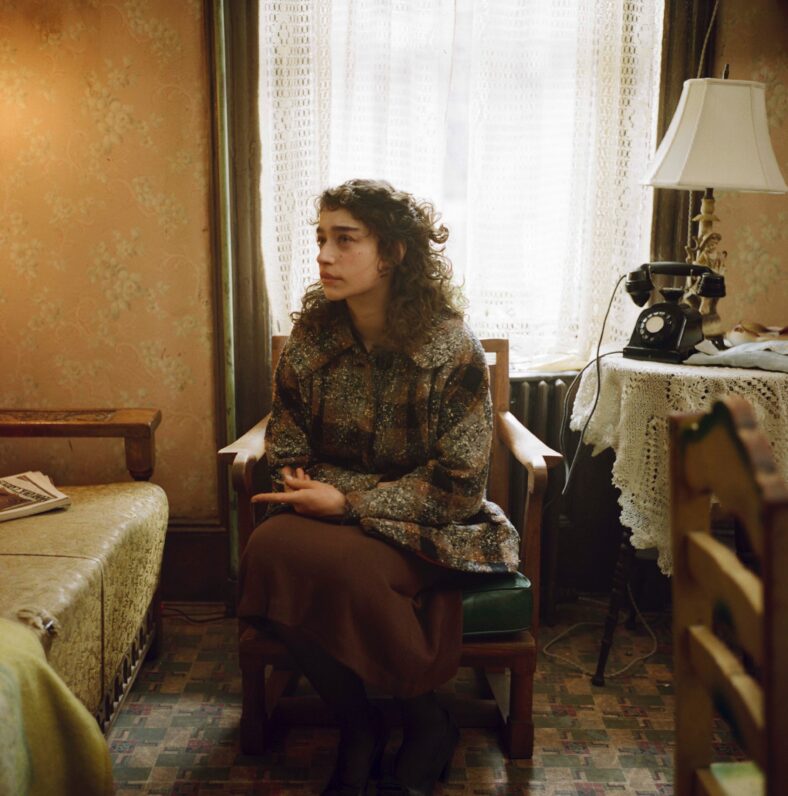
“When you look and you’re doing research for this period, a lot of it is in black and white,” says Bellizzi. “So you have to envision what color the world is in color.”
That was especially true of the team uniforms during the Wembley sequences.
“In general, they’re always in black polos,” Bellizzi says. “But I didn’t want the room to just be all black shirts.”
Dressing everyone in black would have collapsed the visual depth of the frame. Bellizzi needed to preserve historical logic while ensuring the audience could distinguish between teams during fast-moving competition.
So she designed each team individually, introducing variation through color, fabric and construction. She kept major teams such as England, Germany, Japan and the United States in black to reflect historical prominence, but gave other teams distinct color identities to maintain clarity and scale.

“Hungary was green, Sweden was blue, India was burgundy,” Bellizzi says. “I wanted to really show that.”
Execution required enormous coordination. Bellizzi and her team built and organized hundreds of uniforms, each with handmade insignia and carefully selected materials. Every garment had to maintain continuity across shooting days while accommodating blocking, camera placement and performance.
“That was probably one of the biggest days on camera, in terms of the amount of people that we had to dress,” Bellizzi says.
Marty Supreme Costume Designer Miyako Bellizzi on Reflecting Personal Histories

Bellizzi applied the same level of specificity to the film’s female characters, many of whom required custom wardrobes built from scratch. Unlike Marty, whose clothing evolves through repetition, characters like Rachel (Odessa A’zion) and Kay (Gwyneth Paltrow) required garments that reflected period accuracy and physical reality.
To make 1950s maternity wear, for example, “they would just cut circles outside of their skirts and then tie it up with the ribbon,” Bellizzi says. So she followed that.
Bellizzi designed the women’s clothes to include details that might escape the audience. But they shape silhouette, posture and presence in subtle ways.
Continuity presented another challenge. Several sequences unfold across a single day, requiring Bellizzi to track garments carefully across scenes filmed weeks apart. Clothing had to appear consistent even in a high-stakes scene when Marty throws on clothes while running out the door.
Bellizzi focused, above all, on how clothes served the story and characters.
“You have to have an understanding of what they’re doing first,” Bellizzi says. “And then that helps determine what they’re wearing.”
Main image: Timothée Chalamet in the durable, period-accurate clothing of Marty Supreme. A24.


