


One Battle After Another is so layered that even cinematographer Michael Bauman is still discovering new gems, long after wrapping production.
“I think it’s interesting that so many layers are happening in every scene,” the first-time Oscar nominee tells MovieMaker on a Zoom call from Europe, where he’s shooting a new season of Netflix’s Monster. “It’s an action movie, and even if you don’t totally understand all these unique characters and the plot twists, the energy just keeps propelling you forward.
“You come back and you watch the film a few times, and you just discover so many new things about it because there’s just so many different layers that are happening,” he continues. “Sometimes I watch it and it’s like, ‘Oh, wow! This is something I didn’t notice on the day.’ It’s definitely a gift that keeps giving.”
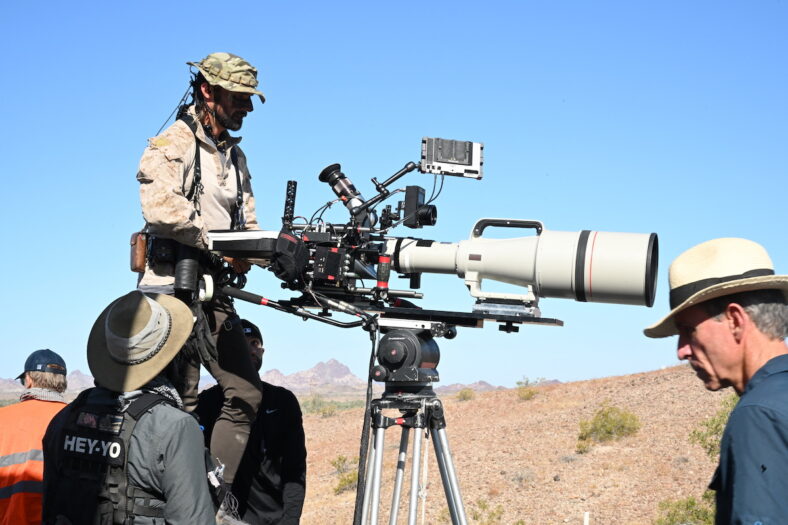
Gluing together all of the elements at play in the Paul Thomas Anderson film — which has 13 Oscar nominations, including for Best Picture of the Year — is a frenetic energy. Bauman and his team harnessed it with VistaVision — a specialized motion picture camera that runs 35mm film horizontally through the gate, capturing an image across eight perforations instead of four, leading to a much larger, higher-resolution negative that translates well on IMAX screens.
“A thousand-foot magazine would last about four to five minutes, versus on regular 35mm, it’s about 11 minutes,” says Bauman, who ran through 1.5 million feet of film for the 162-minute movie. “Jackson Davis, who was our loader, he was just flying. It’s a lot, and the VistaVision camera will jam, and sometimes, when it jams, that means you’ve got to get rid of that mag, put a new mag on. So, he always had to have a bunch of magazines ready, because if anything jammed, he had to be able to jump right back into it.”
One Battle After Another DP Michael Bauman on Running With Scenes
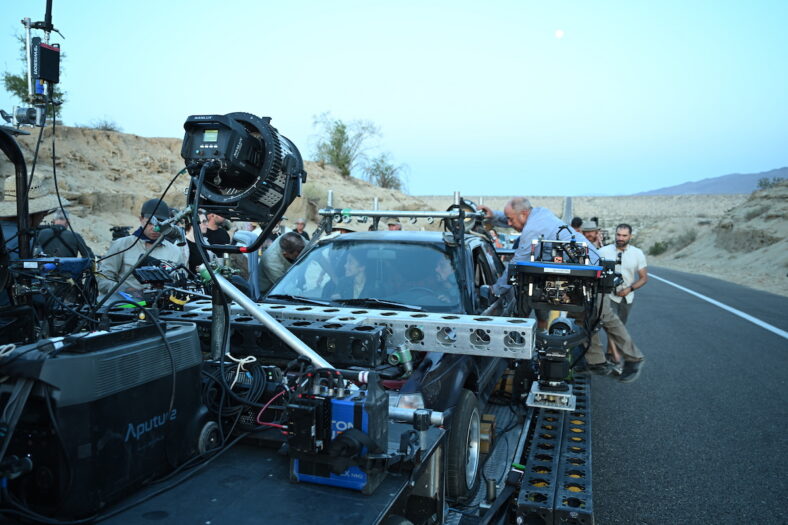
Bauman describes his experience shooting One Battle After Another as “being on the knife’s edge,” because most of it was on location instead of a sound stage, and Anderson’s approach to directing revolved around giving actors elasticity and space to explore through their performances.
“You just had such great actors all the time,” Bauman says. “We knew what the location was, but there were so many factors and elements that would happen during the day that we just incorporated into the workflow, and so that can be really interesting at times.
“We could just see as scenes evolved, and run with them a bit. And there were a lot of moments like that,” he continues, pointing to the riot scene as one that took on a life of its own using local talent while shooting in El Paso, Texas. “The energy they had going on was just something we leaned into as much as possible.”
But before the filmmakers could embrace the collective energy unfolding in the environment, they had to be prepared to rely on a vintage camera that Bauman describes as “its own personality.”
“We did a lot of tests before the movie started, to just kind of really see how far we could push everything, and what kind of things had to change on the camera so the reload times would be faster,” he explains. “So when the vibe is going, you just want to keep capturing it as fast as it’s happening. And so it was really about setting us up for success in some of the prep work we did.”
Bauman studied 1970s low-budget cinema for inspiration, including The French Connection and The Last Detail: “Some of these kinds of movies that just had a rough look to them and had an energy to them that was really critical, that [Anderson] really wanted to capture. And so, that kind of trickled into everything.”
The entire sequence capturing the chaos of Bob (Leonardo DiCaprio) escaping a sanctuary city flooded with immigration agents, with the assistance of a very busy Sensei (Benicio Del Toro) and his rooftop-hopping lieutenants, was among Bauman’s personal favorites to shoot.
“The end of the film was incredible, but there’s so many little things, like the rooftops, and them going through the apartment and [DiCaprio] ending up on that phone call. Just the energy of that moment and the things that happened are really great,” he says.
The climax of the film is a car chase over the hills and through the California desert after Bob’s daughter, Willa (Chase Infiniti), escapes from the clutches of Col. Lockjaw’s G.I. goons, only to be pursued by an assassin sent by Christmas Adventurers Club.
High tension takes over the highway as two roaring muscle cars rise and fall out of view, while Bob’s buzzy beater trails behind. It’s classic cinematic juxtaposition, cut brilliantly by fellow Oscar nominee Andy Jurgensen, and then perfectly complimented by an Oscar-nominated score and sound design, as well.
“I think what really makes that scene is just the energy for it. Not just visuals, but also sound design and the score,” Bauman says. “[Johnny Greenwood’s] scores are always great, but that one is really the pinnacle: how he’s introducing the drums, and then he starts introducing the strings, and then the drums go away, and then she sees the car come over, and the drums kick back in again.”
Like so many other scenes Bauman shot for One Battle After Another, this one was also shaped by discovery in the moment, starting with supervising location manager Michael Glaser stumbling upon the unique road while scouting for another scene, and then getting Anderson, Bauman and the rest of the team to travel four hours outside of L.A. to see it for themselves.
“It wasn’t until we actually saw the location that it was like, wow!” says Bauman. “[The script] wasn’t like, ‘I need a road with a bunch of hills.’ Once we saw it, it was like, ‘Okay, now we can really take it in this direction.’”
“You had to have a team that was on board with, like, ‘Okay, here’s the plan — but we’re going to take the plan this way.’ Not everybody’s wired like that,” Bauman continues. “And so, yeah, this was one example of it. As we kind of started to find the rhythm of it, and we started to find the locations, just even starting with the iPhones and getting video of it. This is how the juices start flowing.”
“Plans are great,” he concludes, “but the magic of having people in a room and in a space, you want to lean into as much of those opportunities as they happen, and don’t be like, ‘Oh no, we need to be this.’ That, for me, is what I really learned on this movie.”
One Battle After Another is now streaming on HBO Max.
Main image: (L-R) One Battle After Another camera/Steadicam operator Colin Anderson, writer-director Paul Thomas Anderson and director of photography Michael Bauman. Photo by Merrick Morton / Courtesy Warner Bros. Pictures


