


Train Dreams is a cinematic exercise in the art of adaptation: Not only did writer-director Clint Bentley adapt Denis Johnson’s beloved novella of the same name into an Oscar-nominated screenplay, he and cinematographer Adolpho Veloso also had to constantly adapt to conditions they encountered while shooting in the wild forests of the Pacific Northwest.
“What didn’t go wrong?” Veloso jokes while speaking to MovieMaker Magazine a few weeks after becoming the first Brazilian director of photography to ever receive an Oscar nomination for Best Cinematography. “I’m kidding, but it’s actually true.”
The gorgeous and moving Netflix drama — which also scored Academy Award nominations for Best Original Song and Best Motion Picture of the Year — portrays the life of logger Robert Grainier (Joel Edgerton) as he lives, works and homesteads with his wife (Felicity Jones) and daughter in rural America through the turn of the rapidly changing 20th century.
“Sometimes you want the sun to be out and it’s raining; sometimes you want clouds and it’s sunny; and sometimes you want the two-year-old actor to be happy, and the two-year-old is crying. You never know what you’re going to get,” he continues. “You can either just be frustrated with those things and try to fight them, or you can realize there is an opportunity.”
“The amazing thing about Clint that I learned a lot from,” Veloso adds, “is to be open to whatever comes your way, and not necessarily to stick with your previously conceived idea of things.”
The filmmakers prepared for freedom to pivot in production by creating a few “basic rules” that guided the overall look and how specific moments of the character’s life should be portrayed.
“So that even with the fact that we were adapting and improvising,” Veloso says, “we had a language and a rule to follow, so it felt accurate to the movie in a way.
“Our basic rule for Train Dreams came from wanting the movie to feel like you’re watching someone’s memories in a very organic way; not like reading a journalistic version of that person’s life, but memories that are kind of random, sometimes out of order, sometimes even inaccurate.”
They wanted the film to feel like viewers were digging through a box of pictures from Robert’s life, a visual metaphor that inspired the 3:2 aspect ratio, which stands out as a dramatic choice in a widescreen world.
“Because that’s the still photography aspect ratio, in general,” he explains, before sharing more loose rules: “From how to frame it and what to do with the camera, and how we wanted some scenes to feel really posed and formal, like a posed picture, but some scenes to feel like an organic picture. Those rules helped us shape the movie and to be consistent within the improvisation.”
Train Dreams DP Adolpho Veloso on Shooting Continuously for 40 Minutes or More
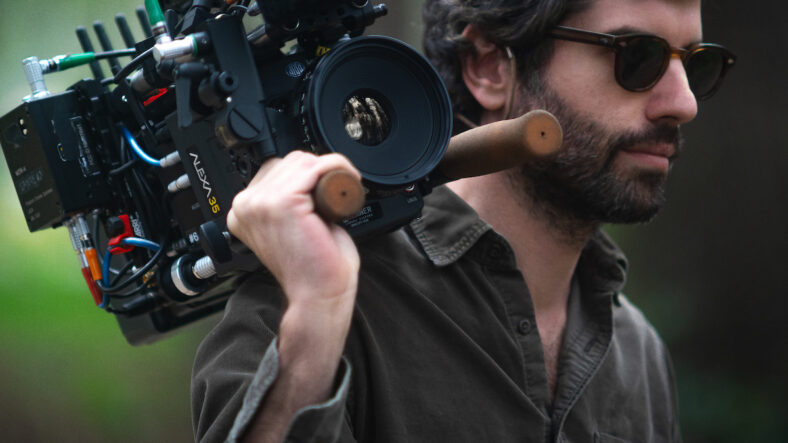
Even the decision to shoot digital photography on the Arri Alexa 35 instead of using film stock was inspired by the challenging realities of working almost exclusively on location, all while relying on natural light and forms of fire to illuminate the scenes.
“We did think briefly about film,” he says. “But we gave up really fast for a lot of reasons; one of them being budget and time, but mostly because we felt that a lot of the things we wanted to do with the movie … would not be possible with film.”
They often shot for periods of 40 to 50 minutes without yelling cut, something that would require multiple reloads on a film camera. “We thought that it was more important to let the actors have more freedom and to inhabit those spaces,” he says.
The 3:2 aspect ratio also gave more headroom in frame to help capture those gigantic trees, who the filmmakers viewed as essential characters in the story.
“I feel like we are realizing, more than ever, how much we affect nature, and nature affects us back,” says Veloso, whose experience in the natural world includes filming in the Amazon.
“Whenever you have the privilege to go to a really old forest, for example, I think it’s really hard not to feel different, even the air feels different,” he says. “It’s important also for people to realize that, and I feel like that’s the main reason we wanted in this movie to portray nature as a character — to make sure it had a voice in the movie, like any of the other characters in the movie.
“So all the thought behind how to shoot it was always like, ‘Are we framing [a tree] the same way we would frame if this was a person, or are we shooting just a postcard’?” he continues. “So, whenever we landed on, ‘Okay, there’s a postcard,’ we wouldn’t shoot it this way. That’s the reason we don’t have a drone shot in the movie, for example.”
Win or lose at the 98th annual Academy Awards on March 15, Veloso already has more films on the horizon, starting with Queen at Sea, which just premiered at the Berlin Film Festival in main competition, followed by M. Night Shyamalan’s Remain, hitting theaters next February.
“I’m really looking forward to getting my inbox and script from Clint saying, ‘This is the next one,’” he tells MovieMaker, noting it’s been hard to even find time to read and consider any scripts amidst this “award season craziness.”
Whatever project his lens lands on next, though, Veloso says he hopes to feel as personally connected to it as he did Train Dreams.
“I feel like Train Dreams is the script that I read in my life that I connected the most with. I could see myself in the character for a lot of reasons,” he says. “Seeing what a special movie it is, and having my work recognized by it, I feel like whenever you do work on something that you truly believe in, that you can connect with… you can probably do a better job, because you understand it deeply.”
Train Dreams is now streaming on Netflix.
Main image: Train Dreams cinematographer Adolpho Veloso. Photo by Daniel Schaefer/BBP Train Dreams. LLC


