


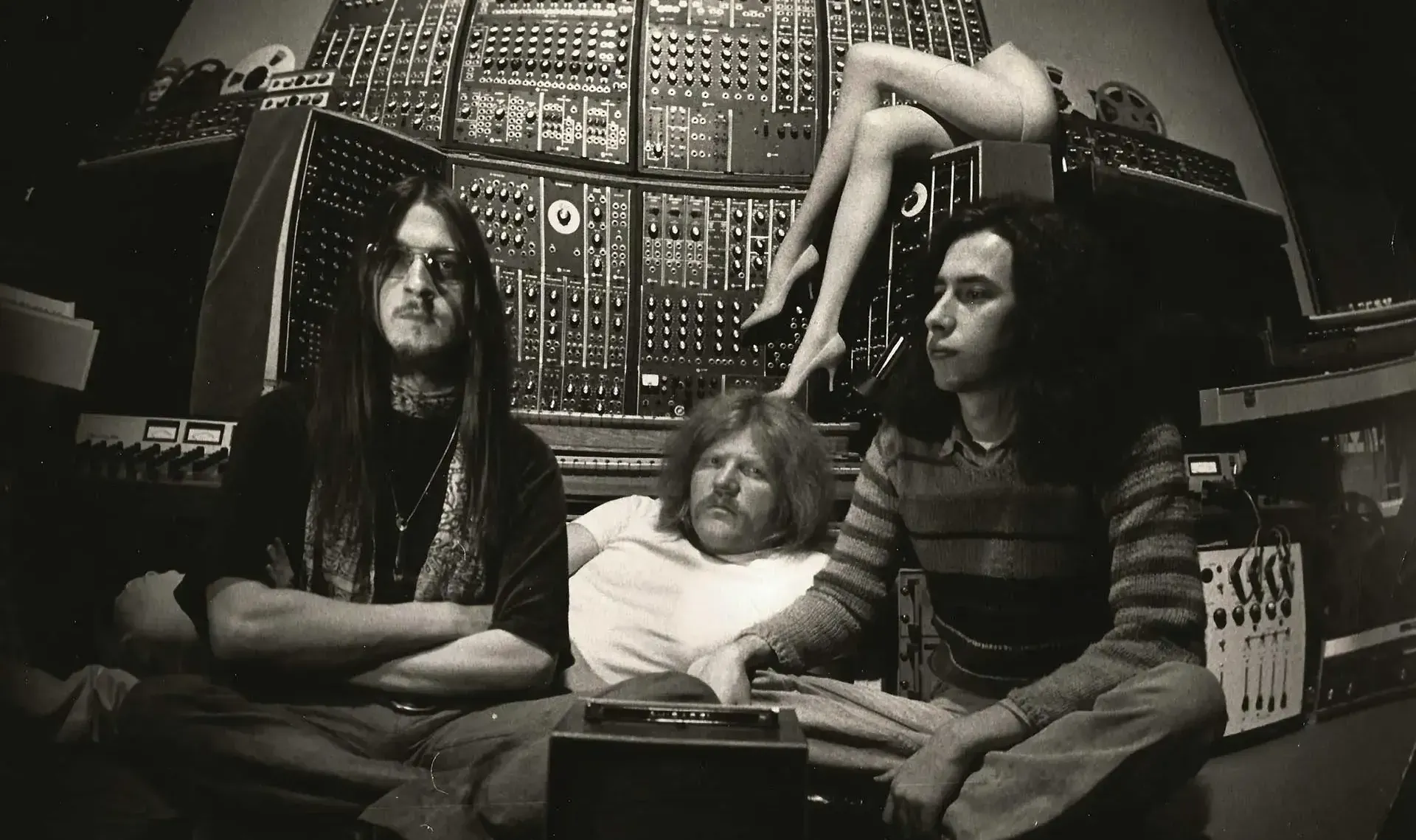
Mention Tangerine Dream to anyone who watched films in the 80s and watch what happens. Eyes light up. “Oh god, Thief.” “The Keep soundtrack — I’ve been trying to find that for years.” “That Risky Business track.” “Wait, they did Near Dark too?”
In nostalgia circles, film forums, and retro soundtrack communities, Tangerine Dream aren’t forgotten curiosities. They’re legends. Their work gets referenced constantly, sought obsessively, discussed reverently. Those pulsing arpeggiators, vast synth pads, and propulsive sequences that defined 80s thriller cinema? Everyone remembers them.
Here’s what makes absolutely no sense: they achieved this iconic status despite Hollywood doing everything possible to bury their work.
Soundtracks unreleased for decades. Legal battles that kept scores locked away for 37 years. Excluded from hit albums in favour of pop compilations. Systematically squeezed out by the MTV revolution. Shafted on rights, marketing, and distribution at nearly every turn.
The German electronic pioneers scored over 60 films between 1977 and 1990, creating the sonic blueprint for neo-noir, sci-fi tension, and atmospheric horror. Yet the industry treated them like disposable contractors, buried their best work in legal limbo, and tried to erase them from the very genre they’d invented.
They became legends anyway.
This is the story of how Tangerine Dream’s music was so powerful it survived everything the film business threw at it — and why their legacy endures despite the industry’s best efforts to kill it.
Thank You, William Friedkin
Let’s be clear: none of this happens without William Friedkin.
The director of The French Connection and The Exorcist saw Tangerine Dream perform live in Germany during the mid-70s and experienced what he’d later describe as a revelation. Forget everything you know about how film music should work — Friedkin watched three Germans surrounded by walls of synthesizers and heard the future.
“I was touring Europe and Asia in 1974 for The Exorcist. Whilst in Germany, someone from Warner Bros. mentioned to me that there was this incredible concert due to be held at an abandoned church in the Black Forrest at midnight… The music was unbelievable. It was an extraordinary revelation to me.”
When he needed a score for his 1977 thriller Sorcerer — a doomed, brilliant remake of The Wages of Fear — he hired electronic musicians nobody in Hollywood had heard of. Studio executives must have thought he’d lost his mind.
The film bombed spectacularly. But Tangerine Dream’s soundtrack reached the US Top 200 and charted at #25 in the UK, becoming their third highest-charting album.
Friedkin saw what Hollywood couldn’t: that Edgar Froese and his rotating collective weren’t just making weird noises with modular synthesizers. They were creating genuine cinematic emotion, atmosphere that could carry narrative weight, soundscapes that felt both ancient and utterly alien.
Hollywood took notice. Doors opened.
For a band that had spent the early 70s pioneering what they called “kosmische musik” in Berlin’s underground clubs, this was unexpected. Froese had formed Tangerine Dream in 1967 as a psychedelic art project. By the time Friedkin found them, they’d evolved into something genuinely unprecedented: a band that could make modular synthesizers and sequencers sound emotional, cinematic, profound.
The Sorcerer score proved electronic music could carry narrative weight. Studios started ringing.
Set the mood…
The Michael Mann Years: Creating the Neo-Noir Sound
Thief changed everything.
Michael Mann’s 1981 directorial debut starred James Caan as a professional jewel thief trying to go straight — and failing. Mann had initially planned to use Chicago blues throughout. But he was a fan of Tangerine Dream’s 1979 album Force Majeure, and thought their urgent, mechanical sound would better capture his protagonist’s existential crisis.
He was right. The nine-minute opening sequence — a methodical vault heist set to TD’s pulsating electronics — announced a new kind of crime film. This wasn’t your father’s noir. This was neon reflections on rain-slicked streets, synthesizers instead of saxophones, propulsive dread instead of melancholy.
The score became instantly iconic. Track “Igneous” was actually a reworked version of “Thru Metamorphic Rocks” from Force Majeure — a working method TD would employ repeatedly, cannibalising and reimagining their studio albums into film scores. Clever economics, but it would create rights nightmares later.
Mann even asked for a Pink Floyd-style “Comfortably Numb” finale. When TD couldn’t deliver, he brought in composer Craig Safan for the closing track “Confrontation.” Different editions of the soundtrack album included or excluded this track, depending on territory — an early sign of the release chaos that would plague TD’s film work.
I was shocked to hear about the loss of Edgar Froese. It seems as if we were working together about fifteen years ago, not thirty-five… Earlier, I had been divided between choosing music regionally native to Thief, Chicago Blues, or going with a completely electronic score. The choice was intimidating because two very different motion picture experiences would result. Right then, the work of Tangerine Dream, Kraftwerk and Faust was an explosion of experimental and rich material from a young generation coming of age out of the ruins and separating itself from WWII Germany. It was the cutting edge of electronic music. And, it had content. It wasn’t sonic atmospheres. There was nothing in the UK or the States like it.
Still, Thief established the template. Mann returned to TD for his 1983 horror film The Keep.
What happened next became legendary for all the wrong reasons.
The Keep: A Holy Grail Buried for 37 Years
Mann’s adaptation of F. Paul Wilson’s supernatural Nazi horror novel should have been a masterpiece. He shot a 210-minute director’s cut that those who saw it called visionary. Paramount took one look and panicked. They forced him to slash it to 96 minutes.
The theatrical release is famously incomprehensible — beautiful, atmospheric, bewildering. Of the sixteen tracks Tangerine Dream composed, only four made the final cut.
But here’s where it gets properly bizarre. The soundtrack was scheduled for release in 1983. Virgin Records even assigned catalogue numbers. Then… nothing.
Huge shout-out to DM Edit for this amazing modern trailer:
Fans tell stories — possibly Mandela effect, possibly true — about seeing The Keep vinyl in record shops, going home to get money, and returning to find all copies withdrawn and destroyed. “Nebulous legal reasons,” staff said. No concrete answers.
The truth was messier. Virgin owned TD’s recording rights. Paramount owned the film. With a bombed movie and multiple stakeholders fighting over unused material, nobody wanted to spend legal fees sorting it out. Cheaper to bury it.
So the soundtrack became a ghost. A limited run of 150 CDs sold at a UK concert in 1997. Another 300 copies in a 1999 “Millennium Booster” set. And bootlegs — at least 21 different bootleg versions circulated among collectors, none complete, none official.
Kit Rae, a TD megafan, documented the entire saga online. The bootleg community became obsessive. Some claimed to have the “real” version. Others compiled fragments from studio leaks, a 1985 German radio broadcast, even the film’s laserdisc release.
It wasn’t until 2020 — 37 years later — that The Keep got a proper official release, as part of a ten-CD box set. Even then, three tracks were omitted, the sequence was different, and purists argued it still wasn’t the “real” score.
For a soundtrack from a failed 1983 horror film, the obsession seems disproportionate. Until you hear it.
When Pop Ate the Soundtrack Business
Risky Business should have been Tangerine Dream’s mainstream breakthrough. Tom Cruise’s star-making turn as a suburban teenager running a brothel while his parents are away. One of 1983’s biggest hits.
The soundtrack went platinum. But here’s the thing: the album was packed with pop hits. Bob Seger’s “Old Time Rock and Roll,” Phil Collins’ “In the Air Tonight,” Prince, Journey. Tangerine Dream got five tracks on there, including the sublime “Love on a Real Train.”
That track became their signature piece — later sampled endlessly, borrowed by 90s trance producers, the sonic blueprint for countless chill-out compilations. Yet even casual fans of the film don’t necessarily know who composed it.
By 1985’s Vision Quest, the squeeze was complete.
TD composed the entire instrumental score for the Matthew Modine wrestling drama. Their music threads through training montages, emotional beats, the works. They got composer credit. But the official soundtrack album?
Journey. Madonna. Don Henley. Foreigner. Dio. Sammy Hagar.
Not a single Tangerine Dream track made the cut.
The film was even retitled Crazy for You in the UK, Australia and New Zealand to capitalize on Madonna’s rising fame. Her ballad went to #1. The Vision Quest soundtrack is now on Rolling Stone’s 101 Greatest Soundtracks of All Time list.
TD’s score remained unreleased for decades, surfacing only through fan bootlegs like Tangerine Tree Vol 73: Soundtrax.
What happened? MTV happened. The soundtrack business had transformed completely.
After Saturday Night Fever, Flashdance, Footloose, and Purple Rain, record labels realised soundtracks could generate more revenue than films themselves. But they needed songs with music videos. Tracks that could get MTV rotation and radio play.
Instrumental synth sequences — no matter how brilliant — couldn’t do that.
Geffen Records looked at Vision Quest and saw millions in Madonna singles. They looked at Tangerine Dream’s atmospheric score and saw… nothing they could market.
From Risky Business where “Love on a Real Train” became iconic, to Vision Quest two years later where executives didn’t think their work was even worth pressing. That’s how fast the ground shifted.
Read Next
From the Vault

