


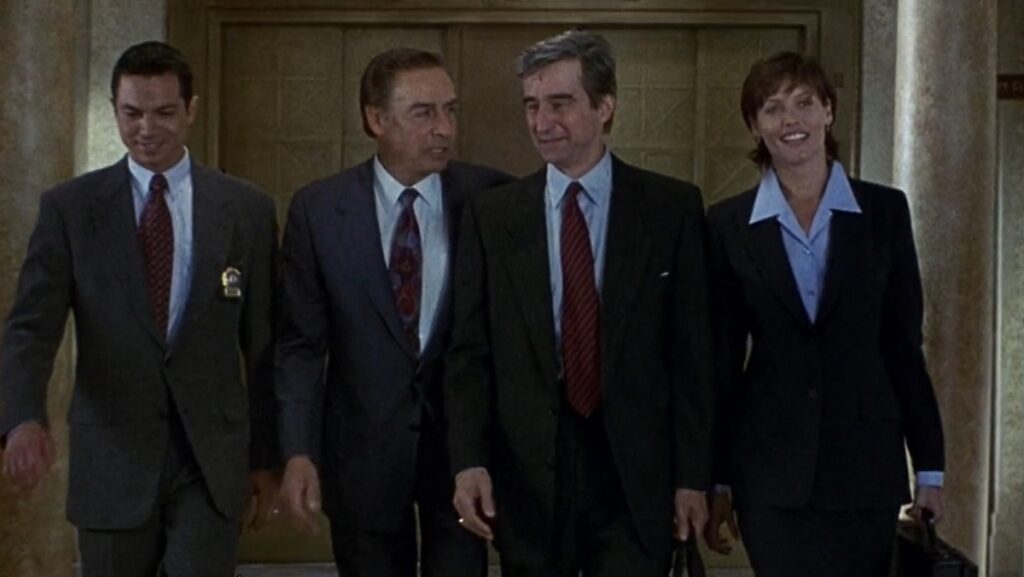

Do you think of Law & Order as revolutionary?
It’s been on so long that it feels like comfort TV, with a predictable formula that you can follow even if you’re tired or depressed.
That may be true 35 years later, but in 1990, Law & Order was something completely new that helped change the crime drama landscape.

The Half-and-Half Format Had Never Been Tried Before
Police shows have always been popular on TV.
There’s a reason Jack Webb became famous for Dragnet and had several incarnations of his show, including a failed attempt by Dick Wolf soon before he hit gold with Law & Order, as well as a parody movie starring Tom Hanks.
Lawyer shows were also popular, whether they were the unrealistic ones, such as cozy mysteries like Perry Mason, or more serious shows like L.A. Law.
But nobody had thought to combine both before Dick Wolf.
He was the first to ask the question of what happens after the cops arrest someone, and put the answer in the same show.

Looking back, this doesn’t seem like nearly as big a deal as it was at the time, but the idea of having the show be half cop, half lawyer was a huge selling point because it was brand new.
There’s a reason this formula was so popular that it spawned multiple spinoffs, a 20-year original run, and a revival that’s been on for half a decade, and DIck Wolf’s media empire.
In another life, I might have been a lawyer.
I love courtroom dramas, questions of rights violations, and all the stuff that happens in the second half of each episode.
Having the cop part come first makes it stronger because you can follow along with the police investigation and predict how the cops’ behavior might help or hurt the case.

The first half, when written well, also evokes those mystery vibes people love.
It’s fun to solve the case alongside the cops and find out if you’re right, and sometimes that even bleeds over into the second half.
Unfortunately, this doesn’t happen as often in modern episodes.
I still remember an old episode where I realized a witness remembered the color of a jacket he couldn’t have seen if he was telling the truth.
It was incredibly satisfying when McCoy pointed out the same error a few minutes later, validating my thought process.
The Formula Wasn’t the Only Revolutionary Aspect of Law & Order

It was cool and all, but the show wouldn’t have lasted 20+ years if all it offered was the gimmick of being two shows in one.
The other, more critical revolution had to do with how the cases were portrayed.
There had been ensemble cop shows before, many of which had moved away from the heroic and flawless cop of earlier eras (Hill Street Blues, anybody?)
However, Law & Order combined the best parts of these shows — the ensemble feel and moral ambiguity — with the best aspects of earlier eras: the focus on cases rather than on the detectives as individuals.
This new direction allowed the series to explore the strengths and weaknesses of the justice system like never before.

Are you obsessed with the Law & Order franchise? If so, I need to hear your voice!
Hit the comments with your thoughts. You’ll get to share your passion with someone who gets it, and I’ll get to write more articles about this show. Win-win!
Dragnet ripped cases from the headlines, too, or at least from the LAPD case files, but it portrayed all cops as tireless public servants who wanted to make the streets safer.
Hill Street Blues presented a more nuanced portrayal of cops, but the characters’ personal dramas were crucial to the series’ success.
Law & Order made its cases feel more gritty and realistic by portraying flawed cops and prosecutors within an imperfect system, without delving into personal stories.
What Other Cop Shows Owe Law & Order

Most police shows now feature a personal drama component.
For some, that’s their charm — Blue Bloods was always about the Reagan family, more so than the cases they dealt with.
However, Law & Order helped birth the movement of grittier cop shows.
Homicide, The Wire, and other similar shows wouldn’t have been as gritty and powerful as they were without Law & Order paving the way.
Many shows also borrow the “ripped from the headlines” formula when it helps them tell their stories.

And even more character-oriented shows, like Blue Bloods, often tackled issues related to justice without taking sides, a trend that first emerged during Law & Order’s original run.
What Are Your Thoughts, Fellow Law & Order Fanatics?
Was Law & Order as revolutionary as it seems? How can the modern episodes get back on track to become a groundbreaking series again?
Your opinions matter. They keep this site running.
Hit the comments with your thoughts and share this article with your friends so they can join in the fun.
Law & Order Season 25 will premiere on NBC on September 25, 2025 — the 35th anniversary of the series’ premiere.
Watch Law & Order Online

-

Believe It Or Not, Law & Order Was Once Revolutionary
Law & Order is never boring, but it is formulaic. Once upon a time, that formula was revolutionary… and it inspired other crime dramas, too.
-

Nobody Asked to Meet the Victims, Law & Order
Law & Order’s formula has made it successful since 1990, so why mess with perfection? It needs to undo this awful change to how it opens each show.
-

The First Episodes of Law & Order Are a Time Capsule That Works
Happy 35th anniversary, Law & Order franchise! It’s refreshing how relevant older episodes still are today.
-

NBC Fall 2025 Premiere Dates — The Hunting Party Benched (For Good Reason) & Dick Wolf Dual-Night Three-Hour Block Returns
NBC’s Fall slate is here, and The Hunting Party is held while Law & Order: Organized Crime returns to Thursday nights. Get all the details!
-

Another Day, Another Law & Order Cast Change…Why Should We Invest?
Law& Order loses cast every season, making it difficult for fans to stay invested. We discuss Mehcad Brooks departure.
TV Fanatic is searching for passionate contributors to share their voices across various article types. Think you have what it takes to be a TV Fanatic? Click here for more information and next steps
The post Believe It Or Not, Law & Order Was Once Revolutionary appeared first on TV Fanatic.
