


As nations gather for talks at COP30 in Belém, Brazil, Eoin Jackson recommends five books that expose the roots and realities of the struggle for climate justice.

COP30 in Belém, Brazil is underway, the 30th effort by states to come together and agree on how to tackle climate change and turn rhetoric into action. It also marks a decade since the landmark Paris Agreement, when governments around the world pledged to limit global warming to (ideally) 1.5°C. Yet, ten years on, the reality remains sobering: greenhouse gas emissions continue to rise, fossil fuel subsidies endure, and those most vulnerable to climate harm remain the least protected.
Now is an opportune moment to take stock, and to ask: why, despite the clarity of the science and the urgency of the crisis, do we continue to fail to act at the necessary scale and speed? The five books below are insightful, provocative works illuminating the moral, political, and historical dimensions of this crisis and the contours of the struggle for climate justice. Together, they identify different branches of climate injustice – from colonialism and capitalism to contemporary geopolitics – and offer lessons on how best to address the inequalities caused by the climate crisis.
 Dark Laboratory:
Many in the West see climate change as something that came to public attention in the late 1980s, amid growing concern about rising greenhouse gas emissions causing extreme weather events like droughts and heatwaves. Some socially conscious individuals may draw further links between these emissions and the Industrial Revolution that led to the extreme reliance on fossil fuels to power major economies. Tao Leigh Goffe’s Dark Laboratory is an effort to show that the origins of climate change go back much further. Her sweeping historical investigation shows how colonial extraction, plantation economies, and the legal and epistemic regimes developed around them produced not only imperial wealth, but also ecological forms of dispossession that echo into our climate present.
In reframing the Anthropocene as a continuation of colonial practices, Goffe positions climate justice as a form of historical redress. Within this framing, domestic emissions targets and carbon budgets alone cannot account for centuries of ecological debt. Instead, Goffe invites us to see climate action as a decolonial project – one that requires transforming not only economies but also systems of knowledge, memory, and belonging.
 Chaos in the Heavens: The Forgotten History of Climate Change
Amid growing concern about extreme weather events, politicians come together with leading scientists to identify the cause, discuss solutions and try to mitigate some of the damaging impacts of climate on society. Sound familiar? Except this is not 2025, this is revolutionary France. And like with the modern climate crisis, the damage caused to agriculture by weather events in 18th-century France exposed questions about social order, governance, and justice.
The consensus around net zero is fraying under populist backlash backed by the same fossil fuel interests that caused the climate crisis.
Through this journey into history, Fressoz and Locher show that past efforts to manage climate risk mirror the tensions we face today: how to balance economic stability with environmental limits, and how to ensure that vulnerable populations are not sacrificed in the name of progress. This recognition can help guide us in idenitfying why it is that humanity struggles to deal with climate change, and also a warning that instabilty in the Earth system can quickly extend into the political system without appropriate action.
 White Skin, Black Fuel: On the Danger of Fossil Fascism.
A common theme in global politics, and a key reason we struggle to make progress on climate action, is the rise of anti-climate populist parties. In one of the first attempts to unpack thesse linkages Andreas Malm explores how the far-right evolved from a nationalistic obsessions with ecological “purity” to its pathlogical defence of fossil fuels and efforts to link climate action with the “woke agenda.” Across Trump’s America, Bolsonaro’s Brazil, and Europe’s far-right movements, Malm and his collaborators at the Zetkin Collective show how narratives of race, sovereignty, and “the people” are mobilised to resist climate action and entrench extractivism.
The book’s argument, made in 2021, has only grown more relevant. In the UK and elsewhere, the consensus around net zero is fraying under populist backlash backed by the same fossil fuel interests that caused the climate crisis. Malm’s analysis underscores how deeply climate politics are embedded in struggles over culture, identity, and democracy itself. For climate justice advocates, the book is both a warning and a guide: defeating the far right’s fossil fuel fascism requires not only technical decarbonisation, but a political project that links environmental repair to strong political narratives that meet the moment.
 The Climate Diplomat: A Personal History of the COP Conferences. Peter Betts. Profile Books. 2025.
Although less justice-focused than other recommendations, former UK climate diplomat Peter Bett’s account of the realities of climate diplomacy is essential reading for any climate justice advocate. Drawing on first-hand experience from successive COP summits, Betts exposes the difficulty of bringing nearly 200 nations each with divergent interests, vulnerabilities, and capacities around a table to agree on a single course of action.
The book offers critical insights into how diplomats engage with civil society, with Betts’ noting that the ability of grassroots movements and NGOs to shift the Overton window is a critical aspect of expanding the range of acceptable options permissible for states. What’s striking for climate justice activists is how little Betts engages with the day-to-day realities of climate injustice in the Global South. Although perhaps unsurprising given it was not his area of expertise, it is a useful reminder that what happens in the backrooms may not always reflect the clamour for equality occurring outside.
At a time when trust in multilateralism is waning, this book reminds readers that though the slow, frustrating process of negotiation remains indispensable, climate justice advocates cannot leave it to diplomats to address the climate crisis.
The struggle for climate justice is not just about emissions. It is about history, power, and imagination – about who has benefited from the destruction of the Earth, who bears the costs, and who gets to decide what comes next.
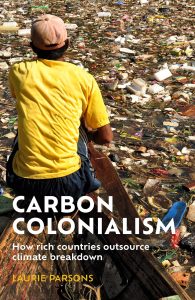 Carbon Colonialism: How Rich Countries Export Climate Breakdown.
The final recommendation examines the dark side of the green transition. Through ethnography and field work, Parsons shows how market-led responses to climate change can underwrite and conceal a continuation of the extractivist logic that underpinned some of the injustices discussed in the previous recommendations. With a particular focus on the exporting of production costs by the West to developing countries (and therefore both greenhouse gas emissions and the associated violations of human rights that come with poor models of manufacturing), Parsons reveals how the costs of the “green transition” are often borne by those least responsible for the crisis. The book’s central warning is stark: unless justice is made central to climate governance, we risk reproducing the same inequalities that created the crisis.
In exposing these patterns, Parsons pushes us to think beyond carbon metrics and toward questions of power, ownership, and accountability. Like with other authors on this list, he suggests that the future must not only decarbonise but also decolonise to ensure justice and fairness for all.
As COP30 unfolds, these books remind us that the struggle for climate justice is not just about emissions. It is about history, power, and imagination – about who has benefited from the destruction of the Earth, who bears the costs, and who gets to decide what comes next.
Note: This post gives the views of the author and not the position of the LSE Review of Books blog, nor of the London School of Economics and Political Science.
Enjoyed this post? Subscribe to our newsletter for a round-up of the latest reviews sent straight to your inbox every other Tuesday.
The post Five books on the struggle for climate justice first appeared on LSE Review of Books.
