


Jordan Ochel is the writer-director of “Healing Hands,” a deeply moving short film about a deaf young boy (Alexander Campos III) whose parents (Mor Cohen and Ruben Javier Caballero) take him to a faith healer (Steven Pounders.) In the piece below, Jordan Ochel recounts the childhood memory that inspired the film, which recently premiered online through Omeleto, .—M.M.
How could I have predicted that this moment would become the short film “Healing Hands”? I breathe shakily. I swallow. Past the spotlights into the dark are ten thousand people staring, waiting for a five-year-old deaf boy to answer the faith healer’s question.
An answer that I knew was a lie.
Thirty years later, this lie became the biggest truth I could tell, a truth told in film. Healing Hands follows Jonah, a five-year-old deaf boy pressured to confirm a faith healer’s miracle in front of a massive audience. But the journey of making this film was not without its heartaches, headaches, and miracles.
Heartaches
For three decades, this experience, this story, was a painful dormant seed. When I was accepted into the master’s program in film at Baylor University I knew this story would be my graduate thesis film. But when it came time to write the script, I spent weeks staring at a blank screen. After all, how do you begin to nurture a story born from a traumatic experience?
I didn’t even recognize it as trauma until, after months of auditions, my first lead actor, a five-year-old deaf boy, dropped out the day before I was to offer him the part.
His mom apologized. “He says the script makes him feel too sad.” In other words, my lived experience was too painful for a five-year-old boy to pretend.
Those words tore open a wound I thought had been a scar.
Truthfully, it says a lot about that young boy’s empathy. But how could I start over in the face of this revived pain? It had been a non-negotiable from the beginning that I find a deaf child actor; if I couldn’t find a deaf child actor, I would abandon the project.
I realized the real challenge was not just telling my story; it was making sure I told it without asking another child to carry it alone.
With gentle words of encouragement from my wife, my parents, my thesis advisor Chris Hansen, and my mentor Maverick Moore (“My Dinner With Werner“), I reached out to the d/Deaf and hard-of-hearing communities online, asking them again to spread the word about my film’s search for a deaf child.
It came down to two families, one of whom had two deaf boys who wear hearing aids. None of them had ever acted before.
I was fortunate that the boy I cast, Alexander Campos III, gave such an honest and phenomenal performance that I quickly forgot he was reenacting my own experiences. He didn’t just perform as Jonah, he was Jonah. But his performance was only possible because his family was enthusiastic and completely on board. After all, this story mattered to them, too.
Headaches
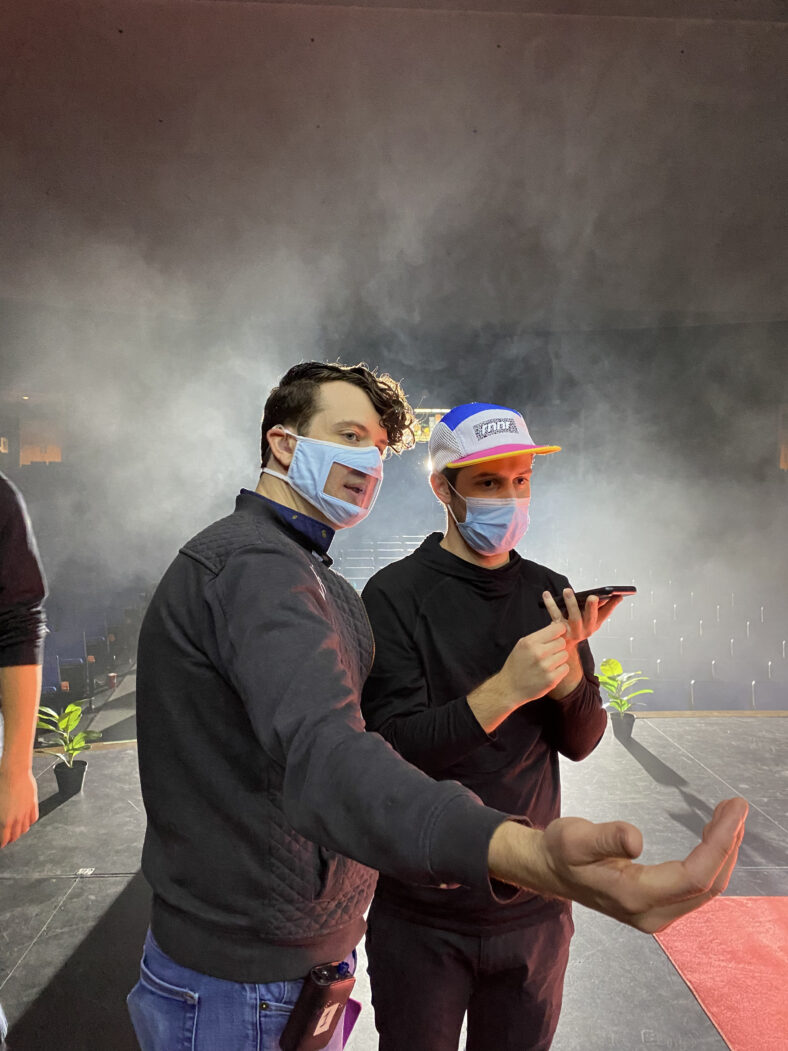
A $10,000 grant, $7,500 in donations, and $5,000 out-of-pocket later, I was deep in the logistical belly of this beast. My amazing DP, Davin Fitch, and I had a challenging shot to plan: the auditorium and audience for the megachurch scene.
Throughout pre-production, several people suggested that I change the scene to be set in a small church. Logistically, it would have been easier. But that just wasn’t the experience I had. I needed the viewers to feel the weight and pressure of a massive, rapturous audience. Like his biblical counterpart, I wanted the audience’s expectation to feel like the great fish bearing down on Jonah, ready to swallow him if he did not say or do the “right” thing. From my perspective and experience, the megachurch setting was the only way to convey this in a short film.
The only question now was how?
We found a stage at a local middle school, but the auditorium was too small and we couldn’t afford hundreds of extras to fill seats. My 1st AD, Dan Beard, recommended a VFX artist he’d worked with, Philip Heinrich. Philip is brilliant and easily punches above his weight class.
His idea?
- Stick LED lights on a dozen of the actual auditorium’s chairs
- Use a Steadicam for the reveal shot
- Purchase a 3D model of an auditorium
- Film a dozen or so seated extras on green screen
- He would track the lights, fill in the 3D model, then randomly assign the green-screened extras their seats, and rotoscope the stage, podium, and pastor
I couldn’t have anticipated how well it would work. I often get asked by filmmakers, “How did you pull off that audience shot?”
The lesson was simple: when authenticity is non-negotiable, the solution is not to shrink the story, it is to build the support system (i.e. an amazing cast and crew) the story requires.
Miracles
I now believe that every finished film, however rough or polished, is a miracle. After all, what drives people to agree to embark on any film together, knowing that headaches and heartaches inevitably await?
People. Relationships. Stories that resonate. These are the miracles that drive any film’s completion.
Since Healing Hands played at festivals (including some on MovieMaker‘s latest list of 50 Film Festivals Worth the Entry Fee, I have heard countless viewers share personal stories about deafness, loneliness, and feeling “not seen.”
In a way that our society is not set up to connect people like me, a single film like this can, for 24 frames per second, bring us together, bonded through a single character in a singular story.
But the real miracle of “Healing Hands” was one I never saw coming: that making this film finally healed me.
It no longer feels like my burden to carry. It belongs to Jonah now. We can all witness his story together. And hopefully, we can look out for other five-year-olds—d/Deaf, hard-of-hearing, or otherwise—with a fresh perspective on the way the great fish of society can swallow them if we don’t pay attention.
Main image: (L-R) Steven Pounders, Alexander Campos III, Ruben Javier Caballero and Mor Cohen in “Healing Hands,” written and directed by Jordan Ochel.


