


Visual effects supervisor Blair Clark has collaborated with Ted creator-director-star Seth MacFarlane to bring the foul-mouthed, pot-smoking teddy bear to life across two films and two seasons of the Ted television series. His job has remained the same: make audiences forget they are watching a computer-generated animated stuffed bear.
“We never want the audiences to get distracted by what they are looking at,” Clark says. “We want them to go with the comedy of the situation in the scene.”
For Season 2 of the comedy, Clark and a team of VFX artists spent close to a year in post production making sure that the teddy bear’s facial features, mannerisms, and costumes — from overalls to a fireman suit — never got in the way of MacFarlane’s performance.
“Ted is wearing the clothes,” Clark says. “The clothes are not wearing him.”
The two Ted movies were released in 2012 and 2015 and together grossed more than $750 million. Prior to the series, a prequel set in Framingham, Massachusetts in the ‘90s, Clark had never worked in television. He was warned that TV production had a much faster pace than film, with less time for specifics. But then colleagues told him the series was “more like a feature than a television show,” he recalls.
“For me, that was great,” he says. “It was comfortable in that I knew what we needed to do.”
Blair Clark on Bringing Ted to Life
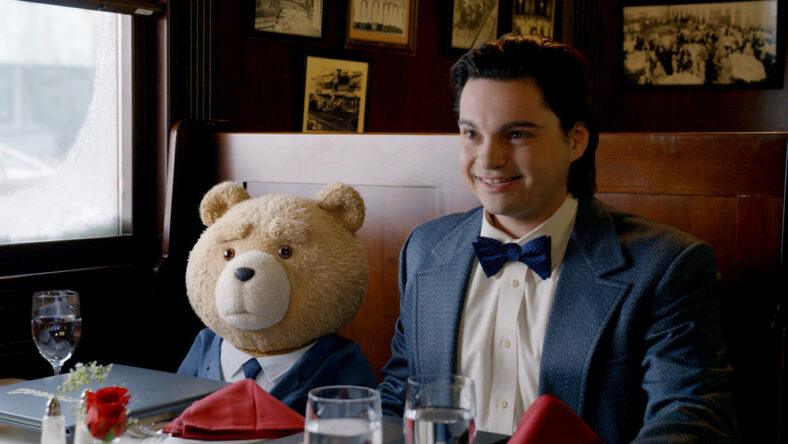
Seasons 1 and 2 required over 3,000 VFX shots used to animate the titular star. Additionally, MacFarlane performed motion capture for two hours each week for approximately 22 weeks.
“It takes months and months because we have to take all of the shots and they all have to be match moved, so that Ted can be integrated in the right spot on any given shot,” Clark says. “When he is doing the mocap, we also have cameras on him, so we can review that footage and fine-tune if there are any questions as far as the nuances of the performance.”
While VFX technology has evolved, Clark has worked hard to maintain the bear’s idiosyncrasies over the last 14 years.
“Ted is a little different than Seth, as far as his mannerisms,” says Clark. “And this is something that was honed and established on the first feature film. We have tried to maintain that, so the character stays consistent throughout the whole story arc, across the features and seasons.”
One of Season 2’s most talked-about sequences involved using AI to turn MacFarlane into a very realistic recreation of Bill Clinton circa 1995. Initially, Clark and VFX supervisor Hoyt Yeatman explored using prosthetics and a wig to transform the actor into the former president. But it wasn’t convincing enough.
While Clark and his team found plenty of high-res photos of Bill Clinton from the mid-1990s, video footage of the former president was “really low quality.” Because Clark couldn’t use standard CGI to make MacFarlane look like a realistic version of Clinton, he and his VFX team turned to AI.
“When the term AI gets thrown out, everybody dismisses it and rolls their eyes,” he says. “Yes, we used AI, but it was used as a tool, and it involved a lot of hard work by a lot of people. It wasn’t like we typed in a prompt and got Bill Clinton.”
Another difficult Season 2 scene came when our stuffed hero makes out with a married woman. On set, the show used a stuffed animal with detachable parts controlled by a puppeteer.
“For a couple shots we had the actor grab the stuffy’s head and make out with it,” Clark says. “At other times, we had just used the stuffy’s torso there so she could just kind of manipulate that.”
The challenge came in post production.
“When she reaches to grab Ted’s shoulders, the actor reaches through his head with one hand for a few frames, so we had to adjust for that,” Clark says. “It involved a lot of fine-tuning those little moments.”
Ted is now streaming on Peacock. You can read more of our Emmy contender interviews here.
