


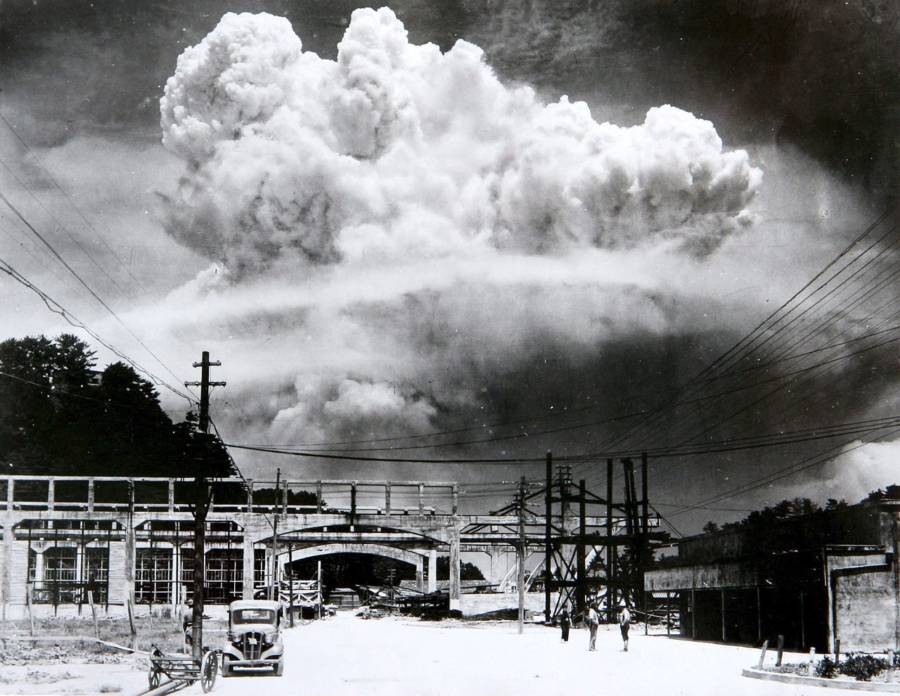
Public DomainThe atomic cloud from the bombing of Nagasaki as seen from a nearby shipyard.
The atomic bombing in Nagasaki on August 9, 1945, was one of the most impactful events of World War II. The attack instantly killed nearly 40,000 people — and six days later, Japan announced its intent to surrender, bringing the war to a close at last.
However, the bombing almost didn’t happen. Nagasaki wasn’t the primary target of that day’s operation, and cloudy weather almost made the U.S. military call off the mission completely. Even when the bomb was dropped, it missed its intended landing spot by two miles, limiting the extent of the destruction.
Still, the impacts were catastrophic. Those closest to the detonation were vaporized, and tens of thousands of civilians — including the elderly, pregnant women, children, and infants — died from burns, radiation exposure, and falling buildings. An additional 40,000 people in Nagasaki perished from related injuries by the end of the year, bringing the total death toll to an estimated 80,000.
Accounts from survivors detail the horrific aftermath of the attack, from the gruesome injuries they witnessed to the destruction of the city. While the atomic bombing in Nagasaki didn’t go as planned, it certainly made a dark mark on history.
The Preparations For Nuclear Warfare
In 1942, the U.S. government teamed up with the U.K. and Canada to launch the Manhattan Project, a program to develop the first nuclear weapons. These bombs were primarily designed at the Los Alamos Laboratory in New Mexico under the direction of physicist J. Robert Oppenheimer.
Testing began on July 16, 1945 — just three weeks before the U.S. military dropped the “Little Boy” on Hiroshima.
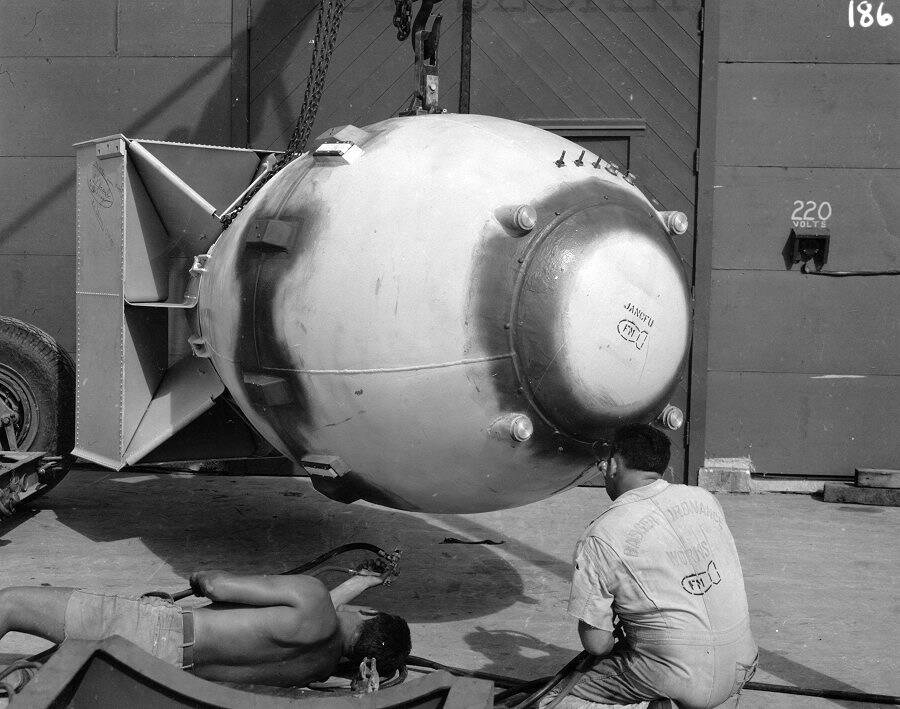
Public DomainThe “Fat Man” bomb that was dropped on Nagasaki just before it was loaded into the Bockscar.
On July 25, 1945, General Thomas T. Handy, the Deputy Chief of Staff of the U.S. Army, issued a directive to General Carl A. Spaatz, the commander of the U.S. Strategic Air Forces in the Pacific. It read:
“The 509 Composite Group, 20th Air Force will deliver its first special bomb as soon as weather will permit visual bombing after about 3 August 1945 on one of the targets: Hiroshima, Kokura, Niigata and Nagasaki… Additional bombs will be delivered on the above targets as soon as made ready by the project staff.”
These locations were selected because they were large cities with key industrial and military facilities. Nagasaki wasn’t initially on the list, but it was added at the last minute due to its port and shipbuilding infrastructure.
On August 6, 1945, the Enola Gay dropped the first nuclear weapon ever used in warfare on Hiroshima. Nearly 80,000 people were killed instantly, and the explosion triggered a firestorm that destroyed almost five square miles of the city.
Still, Japan didn’t surrender — so the U.S. selected its next target.
The Atomic Bombing In Nagasaki
The second atomic bomb was initially scheduled to be dropped on August 11, but a concerning weather forecast moved the mission forward by two days. In the early morning hours of August 9, a B-29 Superfortress called the Bockscar — carrying the “Fat Man” — took off en route to Kokura.
The pilot, Major Charles Sweeney, arrived in the skies above Kokura around 9:45 a.m., but cloud cover and smoke from nearby bombing campaigns obscured the target. By 10:30 a.m., Sweeney had a decision to make: Head to the closest secondary target on the list or discard the bomb in the ocean.
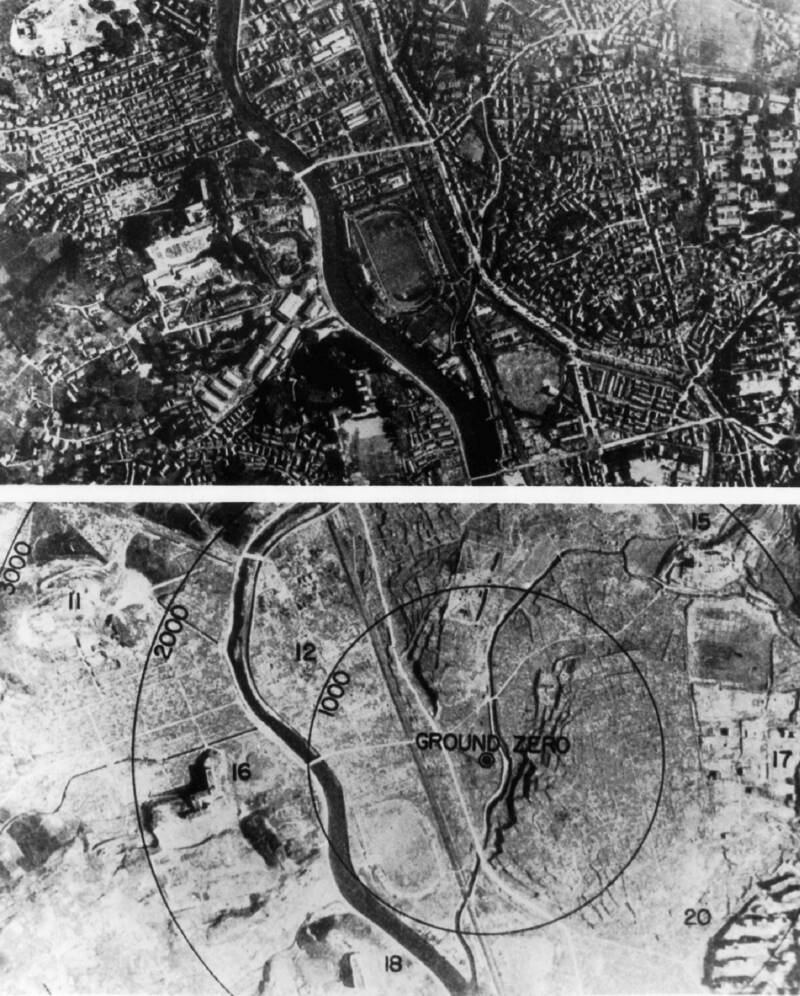
Public DomainAn aerial view of Nagasaki before and after the atomic bombing.
The Bockscar headed toward Nagasaki, which was the only other target within range. The aircraft arrived around 10:58 a.m., with just enough fuel left for a single pass over the city. Clouds obscured the aim point there, too — but at the last minute, a gap opened up. The “Fat Man” was released.
No siren warned the citizens below ahead of the atomic bombing in Nagasaki. An air raid alert had been in effect earlier that morning, but when the Bockscar and its accompanying aircraft were spotted minutes before the attack, they were assumed to be reconnaissance planes.
The “Fat Man” detonated at 11:02 a.m.
New York Times journalist William Laurence was on board The Great Artiste, the plane that was carrying the scientific instruments to measure the blast. As Laurence wrote for the newspaper in a September 1945 report, “[A]ll of us became aware of a flash that broke through the dark barrier of our arc-welder’s lenses and flooded our cabin with an intense light.”
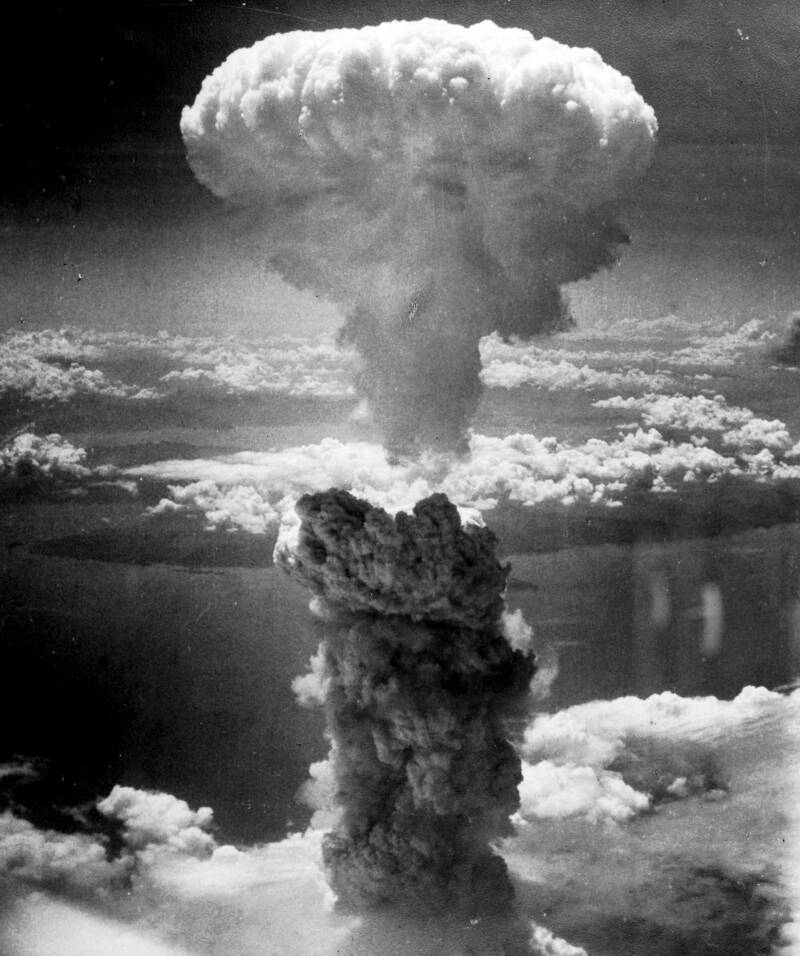
Public DomainThe mushroom cloud over Nagasaki rose more than 11 miles into the sky.
“Observers in the tail of our ship saw a giant ball of fire rise as though from the bowels of the earth,” Laurence recalled, “belching forth enormous white smoke rings. Next they saw a giant pillar of purple fire, 10,000 feet high, shooting skyward with enormous speed.”
On the ground below, tens of thousands of Japanese citizens were experiencing a living Hell.
Survivors’ Accounts Of The Nagasaki Bombing
While the “Fat Man” was 40 percent more powerful than the “Little Boy” — as it was a plutonium implosion bomb rather than a uranium bomb — it didn’t cause as much devastation as the attack on Hiroshima.
Because of the cloud cover, the bomb missed its aim point, detonating roughly two miles farther north than intended. This limited the destruction to the Urakami Valley, as the surrounding hills protected much of the city.
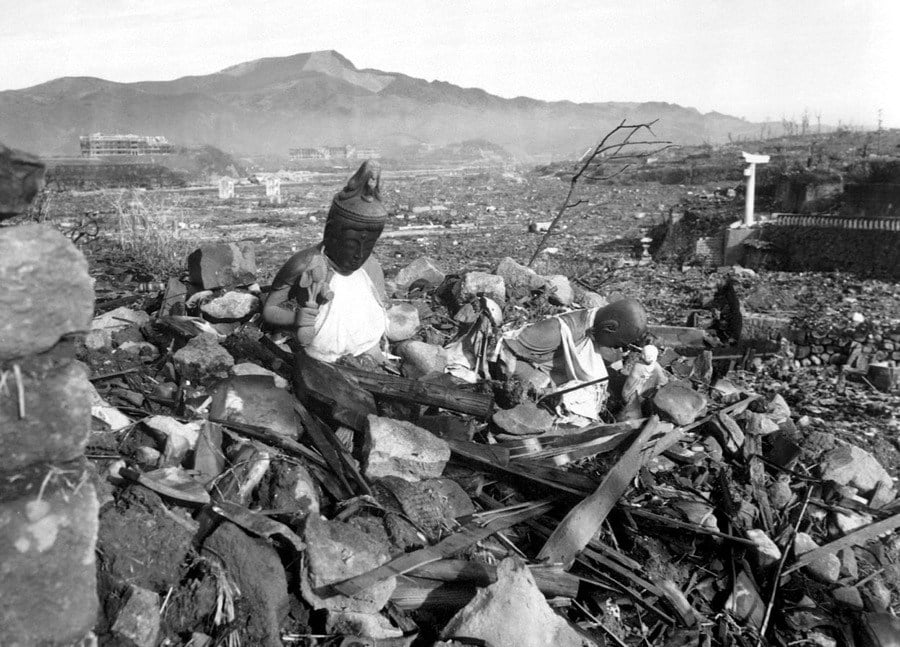
Public DomainThe destruction in Nagasaki six weeks after the bombing.
Still, the atomic bombing in Nagasaki was cataclysmic. Of the 263,000 people estimated to be in the city at the time, around 39,000 were killed instantly. Approximately 25 percent of the homes in Nagasaki were destroyed.
Yoshiro Yamawaki, who was 11 years old at the time, was just sitting down to lunch with his brothers when the bomb exploded. As recorded by Nagasaki Peace, Yamawaki later recalled, “[W]hile we were sitting around the table a whitish-blue light shot across the room. Then came a roar that seemed to shake the whole house.”
“I lifted my head up and looked around to find everything completely changed,” Yamawaki continued. “Almost all the furniture had been mangled and tossed around. The walls had come crumbling down… The roof had been blown off as well, and we could see the sky.”
As he and his brothers walked toward the factory where their father worked, they saw blackened dead bodies scattered across the road — and when they arrived at their destination, they found their father’s corpse in a similar state.
Another survivor, Sakue Shimohira, recalled the injuries she witnessed in the aftermath of the atomic bombing in Nagasaki. Per Nagasaki Peace, she saw “people with charred bodies; people with ripped flesh, covered in blood; people whose eyeballs had burst out of their sockets; people whose burns had swollen their bodies by two or three times.”
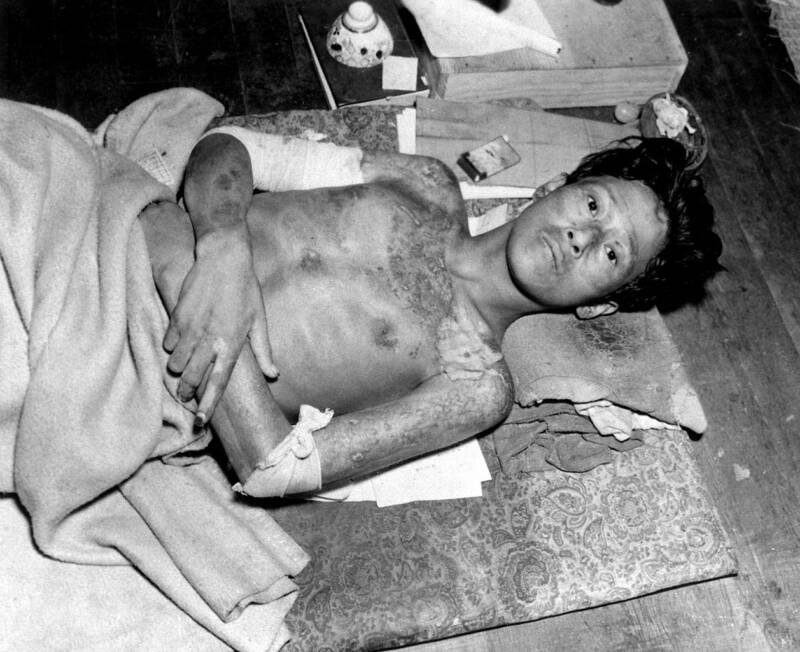
Public DomainMany victims who survived the bombing were left with burns that scarred them for the rest of their lives.
Shigeko Matsumoto was just half a mile from the hypocenter of the explosion, according to the 1945 Project. He was standing in front of the entrance to a bomb shelter at 11:02 a.m. when “the sky turned bright white.”
“My siblings and I were knocked off our feet and violently slammed back into the bomb shelter,” Matsumoto later said. “We had no idea what had happened.” He continued:
“As we sat there shell-shocked and confused, heavily injured burn victims came stumbling into the bomb shelter en masse. Their skin had peeled off their bodies and faces and hung limply down on the ground, in ribbons… Finally, my grandfather found us and we made our way back to our home. I will never forget the hellscape that awaited us. Half burnt bodies lay stiff on the ground, eyeballs gleaming from their sockets.”
The U.S. was ready to drop even more bombs, but they weren’t necessary. On August 15, Emperor Hirohito announced Japan’s intent to surrender.
The Complicated Legacy Of The Nuclear Weapons
While August 15 marks V-J Day, when the world celebrated the end of World War II, Japanese representatives signed the official Instrument of Surrender on Sept. 2, 1945.
The events in Hiroshima and Nagasaki — combined with the Soviet Union’s declaration of war against Japan on August 8 — had forced Japan’s hand. However, critics in both the U.S. and Japan argued that the atomic bombing in Nagasaki and the subsequent deaths of tens of thousands of civilians weren’t necessary to end the war. Others believe that Japan never would have surrendered if not for the attack.
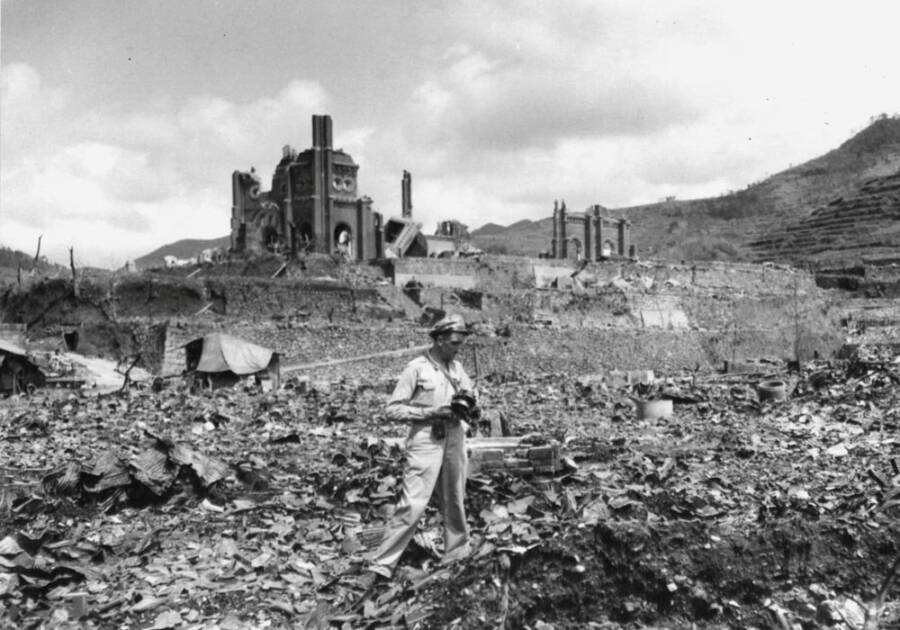
Public DomainU.S. Army Air Forces combat cameraman Dan McGovern documents the aftermath of the Nagasaki bombing in September 1945.
In Errol Morris’ 2003 documentary The Fog of War, former U.S. Secretary of Defense Robert McNamara quoted General Curtis LeMay as saying, “If we’d lost the war, we’d all have been prosecuted as war criminals.”
No matter the lens one uses to look at the legacy of the bombings Nagasaki and Hiroshima, one thing is clear: The world has never been, and will never be, the same again.
As Yoshiro Yamawaki put it, “Weapons of this capacity must be abolished from the earth… I pray that younger generations will come together to work toward a world free of nuclear weapons.”
After this look at the atomic bombing of Nagasaki, see the haunting nuclear shadows of the victims of Hiroshima. Then, go inside the story of the USS Indianapolis, the ship that delivered the components for the Hiroshima bomb before sinking in shark-infested waters.
The post How The Atomic Bombing Of Nagasaki Brought World War 2 To A Violent End appeared first on All That’s Interesting.


