



The Emmy nominations dropped this week, and once again, it feels like a closed loop of the same few shows being rewarded on repeat.
In a year overflowing with scripted content, the Television Academy looked at the landscape and said, “Nah, we’re good with these ten.”
It’s hard to tell whether it’s a lack of imagination or just a reflection of an industry that’s forgotten how to bet on anything new.

This isn’t just an Emmy problem. It’s an entire ecosystem built on risk-aversion.
Broadcast networks, in particular, are stuck in a loop of franchise spin-offs that don’t say anything new, and worse, they’re slashing budgets so aggressively that these shows aren’t even trying to grow into something special.
At this point, the only thing being greenlit is déjà vu.
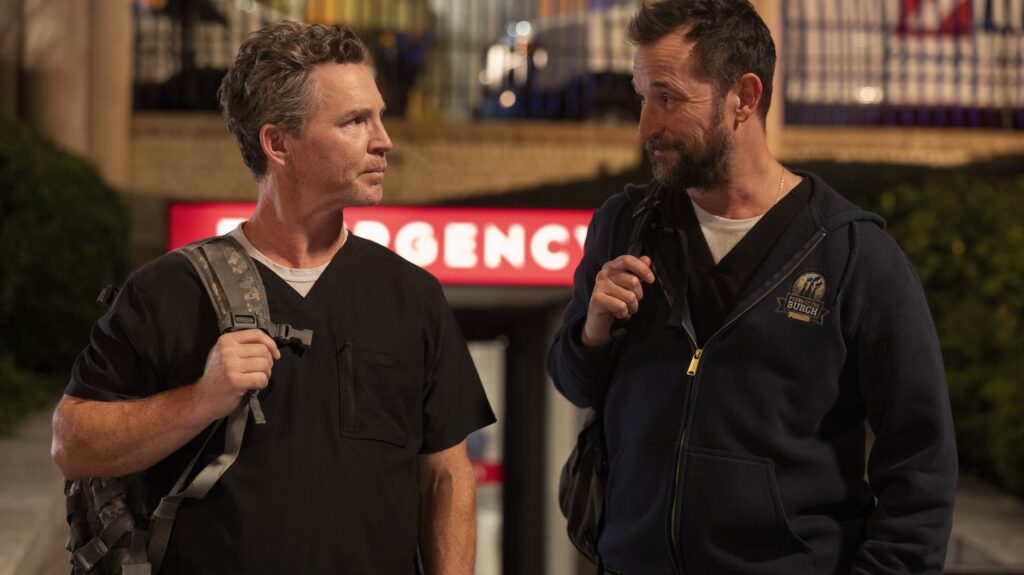
Take The Pitt, a show that proves network TV can still surprise us. It’s a medical drama, sure, but it feels alive. It’s personal, timely, and relevant.
Meanwhile, Netflix’s attempt at something similar, Pulse, fizzled before it got going, because it leaned too hard on the concept and not enough on the character.

One tried to say something new. The other just said, “What if Grey’s, but streaming and in Florida?”
And then there’s Duster. Fresh, stylish, and full of promise, it should’ve been another win for original storytelling. But instead of championing the show, HBO Max dropped it with all the fanfare of a Tuesday afternoon staff meeting.
It had wrapped filming long ago — so long, in fact, that cast options had reportedly expired before it even premiered.
That’s not just bad luck; that’s a decision.

It’s as if the powers that be had already decided viewers wouldn’t care, so they didn’t bother trying to make us. You can’t build excitement for something you don’t even acknowledge exists.
But if you want a great example of expanding IP without falling into a stale formula and a network determined to make it work? Look no further than Showtime’s Dexter: Original Sin and Dexter: Resurrection.
Original Sin leans into nostalgia, yes, but not in a lazy way. It gives us younger versions of the characters we loved while showing us how they became the people we met in Dexter.
It’s lighter, more curious, and rooted in character rather than gimmick.
Resurrection, on the other hand, promises to take a swing in a totally different direction, adding layers instead of just rehashing what came before.

Together, they prove you can play in a familiar world without repeating the same beats.
They’re writing for the audience, not for the algorithm, and certainly not for the critic circles that wouldn’t touch Dexter with a ten-foot scalpel.
There are networks and studios still trying.
NBCUniversal deserves a nod for letting Resident Alien breathe and for greenlighting Revival, which feels like a shot of fresh adrenaline.

But NBC itself? It’s drowning in a sea of sameness, leaning harder and harder on Law & Order and One Chicago as if the solution to franchise fatigue is more franchise.
Even NCIS: Origins, which could have easily defaulted to paint-by-numbers crime-solving, has pivoted into something more nuanced.
It’s not a straight procedural.
It’s using long-gestating investigations and shorter cases to explore who these characters are and how they evolve, rather than just having them quip their way through clues.

And what happens when you recycle the same actors and creators over and over again? Nothing new breaks through.
That’s the cycle we’re stuck in — repetition without evolution.
If you want future franchises, you’ve got to nurture new ideas now. Give new actors a shot. Let fresh voices create.
You can’t expect a garden to grow if all you plant are cuttings from last year.

What’s crazy is that even when existing IP does try something different, it’s met with hesitation.
We’re about to see Yellowstone‘s Kayce Dutton make the jump to broadcast, but nobody knows what that’ll even look like.
It might be more of the same, or maybe (just maybe) it’s a sign someone’s willing to take a swing outside the usual formula.
Because here’s the truth: viewers aren’t the problem.
We do show up for new shows when they’re given half a chance.

Taylor Sheridan’s work proves that. Hulu’s Paradise proves it. Hell, even the first season of The White Lotus proved it.
But networks? Studios? The gatekeepers? They’ve convinced themselves we won’t. They’re writing out of fear, and it shows.
Risk isn’t the enemy — mediocrity is.
You know what to do now!
Whether you agree or disagree, drop below and share your thoughts. Are you as eager for new direction as I am, or are you happy with the status quo?
-

Twisted, Timely, Brilliant: Why Mr. Robot is the Perfect Binge
The Award-winning Mr. Robot dropped on Netflix, and it’s the perfect, timely binge for a whole new audience. Here’s why you NEED to watch!
-

Two Seasons into ER, I Hate Shep So Much You Have to Hear About It
Two seasons into my first ER watch, and Shep is the absolute worst character, and I’m sick of it. Rant loading…
-

Don’t Ruin My Childhood, Netflix: Land of the Lost Is Back in Development
Netflix is developing a reboot of Land of the Lost with the original creators on board — and one Gen X fan has feelings. (Spoiler: It involves Sleestaks, strawberries, and a baby dinosaur.)
The post TV Networks Don’t Trust Us to Watch Anything Original Anymore appeared first on TV Fanatic.
