


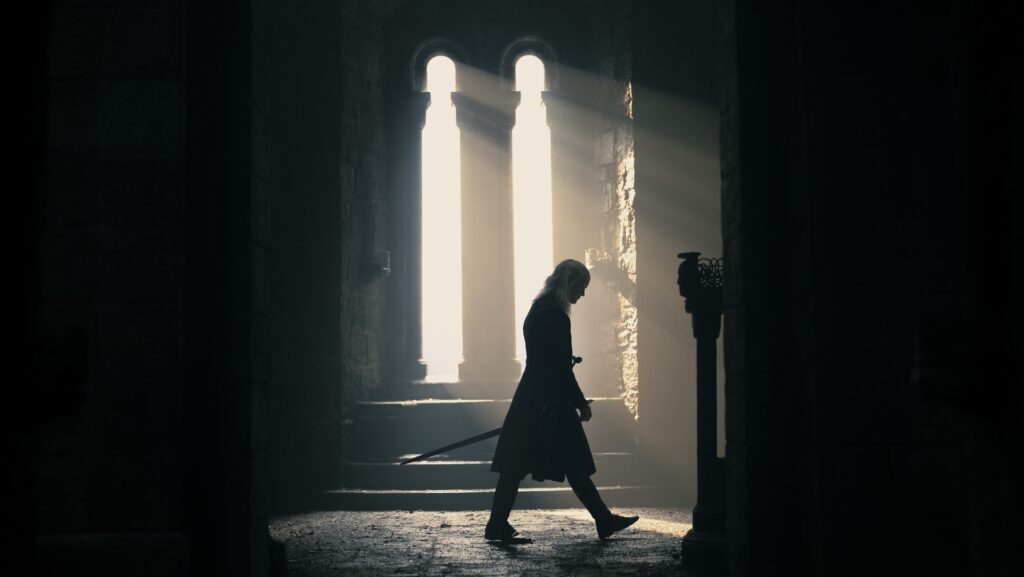

As a disclaimer, my vision is already abhorrent.
A combination of bad genetics and too much time spent reading novels between street lights during car rides didn’t give me the best head start. Once we got into an era of tiny screens and handheld computers at our beck and call, taking us from one glowing screen to the next? Well, my eyeballs were destined to screw me over.
But this isn’t about my crappy vision, it’s about the medium. So, let’s dim the lights and — oh wait, we don’t have to, because TV already did it for us!

For me, the phenomenon and my really noticing it started with Teen Wolf.
I’m pretty certain all of Teen Wolf was illuminated by a single dusty 40-watt warm light bulb and the sheen from everyone’s abs.
Did someone just get bitten? I don’t know. Was that wolf Derek, Scott, or Isaac? Who knows?
What’s that shadowy figure lurking in the background? Wait, is that just Mrs. McCall cooking dinner?
Yeah, I squinted through six glorious seasons of that adrenaline-fueled fever-dream of a series. Still, you bet your perfectly quafted hair, it wasn’t without complaint when I literally could not see what was happening onscreen.

If you’ve ever aggressively blinked at your screen during a climactic battle, adjusted your brightness mid-episode, or watched your own reflection instead of the show, well, congrats!
You’ve encountered The Great Darkness Epidemic of modern television.
So, why is TV so dark—literally
The Cinematic Obsession of Prestige TV
Let’s be real. The second critics started referring to prestige TV as “cinematic,” it was a wrap. Suddenly, directors took it a little too seriously and went way too far.

Next thing you know, they started filming every series with natural lighting, deep shadows, and moody minimalism.
And maybe that works for some shows, but it doesn’t (and shouldn’t) for all of them.
What’s for a Dolby-equipped movie theater doesn’t translate well to a Smart TV in your living room with glare from the streetlight, or to your tablet, laptop, or cellphone screen when an LED lamp is doing serious damage.
Television used to be made for television. Now it’s made for award reels.
And don’t get me wrong, a girl loves visual storytelling. But I also love, you know, actually seeing it.
That Awkward Moment When You’re Not a Visionary Because You LITERALLY Can’t See the Vision

One of the most glaring examples was Game of Thrones Season 8 Episode 3.
The episode was aptly titled “The Long Night,” which worked tenfold since that’s how long people spent watching it, trying to decipher what the hell it was they were watching.
A battle eight seasons in the making, and most people saw … fog? Silhouettes? Maybe a dragon’s wing?
Thousands of people voiced their frustrations on every social media platform available. It likely sparked a dozen thinkpieces and was the primary focus of every single recap and review.
But what did we get out of that? Oh, just the director saying that it was “intentional” and we “weren’t watching it correctly.”
I beg your FINEST pardon?

Cute, cute, but hey, if we need a perfectly calibrated OLED setup just to see Arya stab someone, maybe the issue isn’t our TVs or us, perhaps it was simply how they filmed the episode, no?
Actually getting to see an iconic plot point from a popular series shouldn’t be something exclusively reserved for film nerds and techies!
And no one should have to do a song and dance, adjusting their brightness to accommodate each and every series or film they dare to watch at home.
Darkness ≠ Depth

Dark lighting has become shorthand for “serious storytelling.”
Apparently, if a series wants us to take it seriously, bathe it in shadows. Desaturate everything. Hell, maybe add rain. It’s atmospheric, moody, and it demands our attention!
But maybe the reason it demands our attention so much is because we have to squint and lean forward to decipher what’s happening on our screens.
Not every dark scene adds emotional weight, nor is it necessary to do that.
It’s okay to use darkness and lighting as a tool.

One of the best series in recent years, Paradise does this. Eventually, we come to realize that the dark/light shading, along with the lighting, serve as a tactic to distinguish between past and present events.
And, sure, that’s a fine tactic, but it’s less confusing and just as effective to simply display a timestamp across the screen at the start of each scene.
Lighting Isn’t One-Size-Fits-All
Additionally, in their quest to utilize dark lighting as a storytelling vehicle, they also falter in using lighting to accommodate different skin tones.
Viewers are often surprised to learn that there’s no one-size-fits-all solution for lighting actors. It’s why, sometimes, people appear completely washed out, and the features of others aren’t distinguishable because of how poorly they’re illuminated.
It’s something Queen Sugar MASTERED, by the way.

Sometimes, it already doesn’t work well as a storytelling vehicle, so when dark lighting becomes a default aesthetic, it loses its impact.
Yes, I understand that Matt Murdock is blind, and the series does a good job of bringing us into his world for an immersive experience of witnessing Daredevil protect Hell’s Kitchen.
But do they have to treat us like we’re blind, too?
The Walking Dead, Silo, and even broadcast have become guilty of this, from the One Chicago franchise, notably Chicago Fire and Chicago PD, to Law & Order: SVU. One can’t help but feel as if we’re missing out on critical moments because we can’t always see them.
Disconnection with Tech

Part of the issue lies in how we watch TV now.
Compression from streaming platforms, auto-brightness settings, and even mobile viewing ruin scenes that were finely tuned in a colorist’s editing bay.
If a series had that fine pleasure.
However, it’s also the point. Because if the average viewer can’t see what’s happening, the art needs to meet the audience halfway on that and adapt every bit as much as we constantly have to when we’re watching something.
Television isn’t just for cinematographers or tech geeks. It’s for regular fans, too, the people curled up on the couch or in bed with their pet in their lap and snacks on standby.

It’s for the co-eds sprawled across a tiny dorm room to catch up on the latest episode of their guilty pleasure teen drama via someone’s tablet and a projector.
Or the older demographic lounging in their La-Z-Boy, ready to watch their favorite procedural, despite not knowing how to work every button on the remote properly.
We don’t want to adjust settings mid-scene—we want to see the story.
Let There Be Light!

Fortunately, some shows are already pushing back or demonstrating that you can still tell emotionally rich and complex stories while using proper lighting.
Yes, The Bear is pretentious at times, but the cinematographer is stellar, and whether it’s a bead of sweat on Carmy’s forehead or the bleak vibes of Richie’s apartment, we don’t miss a second.
Everything is distinguishable, and the emotional stakes remain so high that they stress us out with each installment.
Even when Ted Lasso takes emotionally dark turns, they don’t resort to dark scenes to make their point. They trust the audience to follow along, and we do, and get to see everything in the interim.

For all its overrated praise, The White Lotus thrives as a dark comedy about the wealthy elite without actually being dark, which effectively brings that story to life.
We don’t need everything to be bright and bubbly — we just want a balance.
Let the characters themselves and the writing carry the emotional weight of the story, not just the color grading.
I’m Just Saying — Let Us SEE!

TV doesn’t need to be visually dark to be narratively deep.
We shouldn’t have to turn our brightness up 100% to understand what’s happening on the screen or to avoid missing half of the story.
At the risk of sounding like an old lady yelling at the clouds, I’ll leave it here. And I’ll spare you another similar rant: Why is everyone whispering?!
We’re just people who love TV. And sometimes that includes whining about our peeves 😉
A little support goes a long way. Drop a comment, give it a share, or even consider turning off that ad blocker — it helps more than you know.
-

The Summer I Turned Frustrated: It’s Not Jeremiah, It’s the Writing
Is The Summer I Turned Pretty relying on contrived plots to push a romantic endgame it isn’t earning? Here’s why it feels that way.
-

Faith in the Flames: The Nichole Jolly Story Review: Embers, Endurance, and Rising From the Ashes
Faith and resilience collide as Chrissy Metz leads Lifetime’s powerful, inspiring Faith in the Flames: The Nichole Jolly Story. Our review!
-

From Headphones to Hits: 13 Fiction Podcasts That NEED to Be Adapted to the Small Screen
From conspiracy thrillers to paranormal horror to sexy dark comedies… These fiction podcasts have all the makings of a smash-hit TV show.
-

NCIS: Origin’s Lala Problem: Why There Is Only One Way Forward
NCIS: Origins left us gutted with Lala’s cliffhanger. But we’re conflicted because her death is the only outcome that makes sense.
-

These Shows Prove The Emmys Are Failing Broadcast (Again)
Why do The Emmys treat broadcast TV like an afterthought? These series brought heat, heart, and Emmy-worthy content — and got nothing.
TV Fanatic is searching for passionate contributors to share their voices across various article types. Think you have what it takes to be a TV Fanatic? Click here for more information and next steps.
The post Why Is TV So Dark … Literally? appeared first on TV Fanatic.
